Showing posts with label tropics. Show all posts

Sunday, September 22, 2013

The Color of Costa Rica

Chestnut-mandibled Toucan (Ramphastos ambiguss swainsonii) - Hacienda Baru, Costa Rica
Canon 5D Mark III + Canon 300mm f2.8L IS + Canon 1.4x Converter
The Way We See It is on the move!
We have constructed a new gallery / website and blog where we will continue to discuss photography, travel, ecology, evolution and life in Minnesota. Please continue to follow us and our adventures at: http://btleventhal.com


©2000-2013 BTLeventhal.com / Bruce & Tamy Leventhal. All rights reserved. No image on this site may be used without permission. 

Sunday, August 25, 2013

What’s in a Blur (In Search of Creativity)

Green violetear hummingbird (Colibri thalassinus) - Savegre, Costa Rica
Canon 5D mark iii + Canon 300mm f2.8IS L + Canon 2x mark iii


I recently took a look at my neighbor / wedding photographer’s website (see http://brandonwerth.com) and thought to myself... “man that guy is so damn creative!” Being far removed from the portrait/wedding world, this type of photography seems as foreign to me as working with clay. 
Flying Monkey (Cebus capucinus) - Hacienda Baru, Costa Rica
Rather than art, I often describe my work as conservation photography or nature photojournalism. While I always strive to produce the best possible images, I know “creative” is not the first word that comes to mind. At times my work is technical, compelling or emotive, but the word creative is reserved for the artists of the world.
Lapa Lapa Lapa (Ara macao) - Rio Quatro, Costa Rica
To break my current photo-funk, I’ve been on the hunt for creative nature photographs. I know it when I see them, and sadly, this is not what I observe in most of my work. While searching for inspiring photographs of nature, I’ve found many self-described creatives and creativity in post-processing, but the real artists in my discipline seem far and few between. The well-known humanitarian and photo-educator David duChemin is at the precipice of creativity with his portraiture and recent works in nature, but the one I find most compelling is Nick Brandt. Call it retro, but Brandt continues to shoot large negative black & white film while the rest of us toil with our pixels and memory cards. The structure of his images are evocative and expressive in a way that few can extract from their nature and wildlife subjects. There is a depth and emptiness to his images, yet each is filled with the essence of its subject. I call this work creative because Brandt manages to combine the key moment with brilliant technical skills that makes for much more than a journalistic representation of time. I can stare at his pictures for hours.
Flying banana (Ramphastos swainsonii) - Hacienda Baru, Costa Rica
So, what’s with all the burry pics in the blog, you ask? 
During every prolonged shoot, I will break from my tendency towards technical perfection and try to escape from my self-imposed constraints. While I won’t be so bold to call any of these images creative, I might describe each as a purposeful attempt at making art from a bit of nature.

©2000-2013 BTLeventhal.com / Bruce & Tamy Leventhal. All rights reserved. No image on this site may be used without permission.   

Tuesday, August 20, 2013

Costa Rica 2013: My Ficus

The Strangler (Ficus insipida) - Hacienda Baru Wildlife Refuge, Costa Rica
Canon 5D mark iii + Canon 17-40L @ 19mm / f16
This giant of the secondary forest began its life after a clearcut, and has meandered its way towards the sky for the past forty years or so.  With buttresses that top out at six vertical feet and a girth of five man hugs, the tree shares all the characteristics of a typical mid-successional species. It’s a nutrient hog that is pre-programmed to strangle its elders in an attempt to fulfill a biological destiny. Much like the cottonwoods and tulip trees of North America, strangler figs (Ficus insipida) grow fast and large in a race to the top. Once there, they bask in the light of day and propagate effusively with a productivity that feeds a complex tropical web.

This particular ficus has been a favorite photographic subject. Located along a mangrove trail in the Hacienda Baru Wildlife Refuge, the fig tree is a landmark between the lodge and an egret rookery. I am drawn to the curvaceous buttress, asymmetric branches, and its largess. The challenge of capture is my muse. I dream of perfect light that is so rare below a rainforest canopy and am always forced to yield my preconceptions in search of a compromise between what is offered and what I can take. This tree has been pictured here in the past (see “Road-tripping Through Ecosystems #4“) and I am certain that I will shoot and show it again. Ok... so it’s not really my ficus, but I wish it were. 

©2000-2013 BTLeventhal.com / Bruce & Tamy Leventhal. All rights reserved. No image on this site may be used without permission.

Sunday, August 11, 2013

Costa Rica 2013 - Painting with Light

Light Painting with Frogs (Agalychnis callidryas) - Selva Verde, Costa Rica
Canon 7D + Canon 100-400L IS @ 400mm
Exposure: ISO 200 : 6 seconds : f5.6
Used as a way to illuminate foregrounds without flash, light painting adds texture and dimension to star photography and nighttime portraiture. Less commonly applied to wildlife subjects, nocturnal animals are typically photographed with flash traps. While this technique can freeze the motion of an animal on the prowl, subjects caught in a trap often appear startled and unnatural. Additionally, because camera traps are challenging to focus, it’s important use small apertures that will increase the depth of field. The reliance on this technique results in pictures that seem to be littered by branches that reflect the cold and sterile light produced by a flash. 

While traveling through the tropics this July, we had the opportunity to do some light painting. Unlike the millisecond pop of a flash-trap, light painting relies on long exposures to soft light. To paint with light, you’ll need a friend or two to illuminate your nocturnal subject. To emulate the appearance of candle or firelight, we covered the bulbs of our dying flashlights with our hands and slowly moved the light near and around the frog. This type of light painting requires you to prefocus, and bump your iso to 400 or 800. I suggest that you use a stable tripod, mirror lock-up and a cable release in order to minimize camera movement. You’ll need to be prepared to experiment with duration of your shutter, take many pictures and stay up late! 

©2000-2013 BTLeventhal.com / Bruce & Tamy Leventhal. All rights reserved. No image on this site may be used without permission.

Wednesday, July 3, 2013

Costa Rica 2013 : Pre-trip Post #3

Hognose Viper (Porthidium nasutum) - Selva Verde, Costa Rica 2011
Canon 40D + Canon 100-400 f4.5-5.6L IS
It's summer in North America and we're heading to the tropics. Constrained by a pre-defined school schedule, we rarely travel during spring and holiday breaks. In Costa Rica, these are the peak travel periods, and we can't afford peak rates, nor do we wish to endure peak tourist traffic. In the end, this winter retreat has become our summertime  oasis. With relatively few travelers competing for access to prime photographic locations, July and August is both affordable and productive months for those seeking some solitude in the tropics. 
Not Stuttering... Two Toucans (Ramphastos ambiguus swainsonii) - Selva Verde, Costa Rica 2011
Canon 7D + Canon 300mm f2.8L IS
Our batteries are charged and we've got memories to make and memory to burn. Follow us throughout the next few weeks as we explore the unimagined diversity of Costa Rica. 

©2000-2013 BTLeventhal.com / Bruce & Tamy Leventhal. All rights reserved. No image on this site may be used without permission.

Sunday, April 29, 2012

Tip #70: Step Away From Yourself

Aquatic Flowers - Costa Rica
Canon 5D markII + Canon 180 f3.5L Macro @ f4.0
It is comforting to hide behind a false construct like “writer’s block” and “creative deficits.” At a moment of despair, we might claim to have lost the ability to be unique, to say something new, or to see differently. These, I fear, are simply excuses that reward our inherent desire to be lazy. 

Bamboo Orchid (Arundina bambusifolia) - Costa Rica
Canon 5D markII + Canon 180 f3.5L Macro @ f4.0

Nature Photo Tip #70 falls within the despair I have just described. I am tired after a long week of work, I am bored with my library of images, and I fear that I am losing my capacity to “see.” Does this sense of loss sound familiar to you? I experience these feelings regularly, and eventually break free from the self-doubt. Fortunately, research is on my side. While the crutch may be a comfortable one, writer’s block and creative lapses do not exist. What exists is the resistance to do the hard work of writing or being creative. It is not easy to write with clarity, to see differently, or to create something new. However, at the core of our humanity is a complex brain that continually invents and creates. New ideas from old unfold, twist about, and scream to be released. Yet, we are faced with the challenge of articulating this infinite creativity into something real... something that others can see.
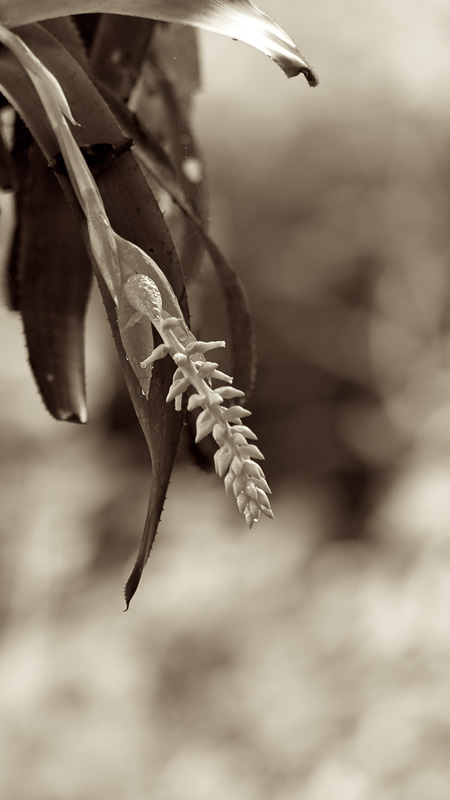
Sepia Bromeliad Bloom - Costa Rica
Canon 7D + Canon 300mm f2.8L IS @ f4.0
When I find myself mired in a creative funk, I work harder instead of less. I reflect on my past work and abandon it like a freed prisoner. I step away from myself and try something new. The images presented are departure from my norm. These are not my typical subjects nor do they reflect my signature image processing style. Don’t let yourself hide behind a false construct, there is no lapse of creativity. Step away from yourself and do the hard work.  
©2000-2012 BTLeventhal.com / Bruce & Tamy Leventhal. All rights reserved. No image on this site may be used without permission.