Showing posts with label vision. Show all posts

Sunday, October 6, 2013

In Search of Simplicity


Leaf and Rock - Interstate State Park, WI
Canon 1D mark iii + Canon 100mm f2.8 USM Macro

It’s a funny thing how a style or pattern seems to creep into the subconscious of our art. I’m not certain if these things happen because of life’s circumstances, or in spite of world around us. Regardless of the cause, it appears that my photographs now seem to emphasize the simple over the complex.

To read the rest of the blog post, check out the blog at our new SquareSpace site at: Simplicity
See our new gallery at: btleventhal.com

©2000-2013 BTLeventhal.com / Bruce & Tamy Leventhal. All rights reserved. No image on this site may be used without permission.

Sunday, August 25, 2013

What’s in a Blur (In Search of Creativity)

Green violetear hummingbird (Colibri thalassinus) - Savegre, Costa Rica
Canon 5D mark iii + Canon 300mm f2.8IS L + Canon 2x mark iii


I recently took a look at my neighbor / wedding photographer’s website (see http://brandonwerth.com) and thought to myself... “man that guy is so damn creative!” Being far removed from the portrait/wedding world, this type of photography seems as foreign to me as working with clay. 
Flying Monkey (Cebus capucinus) - Hacienda Baru, Costa Rica
Rather than art, I often describe my work as conservation photography or nature photojournalism. While I always strive to produce the best possible images, I know “creative” is not the first word that comes to mind. At times my work is technical, compelling or emotive, but the word creative is reserved for the artists of the world.
Lapa Lapa Lapa (Ara macao) - Rio Quatro, Costa Rica
To break my current photo-funk, I’ve been on the hunt for creative nature photographs. I know it when I see them, and sadly, this is not what I observe in most of my work. While searching for inspiring photographs of nature, I’ve found many self-described creatives and creativity in post-processing, but the real artists in my discipline seem far and few between. The well-known humanitarian and photo-educator David duChemin is at the precipice of creativity with his portraiture and recent works in nature, but the one I find most compelling is Nick Brandt. Call it retro, but Brandt continues to shoot large negative black & white film while the rest of us toil with our pixels and memory cards. The structure of his images are evocative and expressive in a way that few can extract from their nature and wildlife subjects. There is a depth and emptiness to his images, yet each is filled with the essence of its subject. I call this work creative because Brandt manages to combine the key moment with brilliant technical skills that makes for much more than a journalistic representation of time. I can stare at his pictures for hours.
Flying banana (Ramphastos swainsonii) - Hacienda Baru, Costa Rica
So, what’s with all the burry pics in the blog, you ask? 
During every prolonged shoot, I will break from my tendency towards technical perfection and try to escape from my self-imposed constraints. While I won’t be so bold to call any of these images creative, I might describe each as a purposeful attempt at making art from a bit of nature.

©2000-2013 BTLeventhal.com / Bruce & Tamy Leventhal. All rights reserved. No image on this site may be used without permission.   

Tuesday, August 20, 2013

Costa Rica 2013: My Ficus

The Strangler (Ficus insipida) - Hacienda Baru Wildlife Refuge, Costa Rica
Canon 5D mark iii + Canon 17-40L @ 19mm / f16
This giant of the secondary forest began its life after a clearcut, and has meandered its way towards the sky for the past forty years or so.  With buttresses that top out at six vertical feet and a girth of five man hugs, the tree shares all the characteristics of a typical mid-successional species. It’s a nutrient hog that is pre-programmed to strangle its elders in an attempt to fulfill a biological destiny. Much like the cottonwoods and tulip trees of North America, strangler figs (Ficus insipida) grow fast and large in a race to the top. Once there, they bask in the light of day and propagate effusively with a productivity that feeds a complex tropical web.

This particular ficus has been a favorite photographic subject. Located along a mangrove trail in the Hacienda Baru Wildlife Refuge, the fig tree is a landmark between the lodge and an egret rookery. I am drawn to the curvaceous buttress, asymmetric branches, and its largess. The challenge of capture is my muse. I dream of perfect light that is so rare below a rainforest canopy and am always forced to yield my preconceptions in search of a compromise between what is offered and what I can take. This tree has been pictured here in the past (see “Road-tripping Through Ecosystems #4“) and I am certain that I will shoot and show it again. Ok... so it’s not really my ficus, but I wish it were. 

©2000-2013 BTLeventhal.com / Bruce & Tamy Leventhal. All rights reserved. No image on this site may be used without permission.

Sunday, August 4, 2013

Costa Rica 2013 - Nesting and the Importance of Perseverance

Adult Male Quetzal #2 - Savegre River, Costa Rica
Canon 5D mark iii and Canon 300mm f2.8IS L w/ Canon 2x mark iii converter
When asked how we find so much wildlife and produce so many unique pictures, my answer is unintentionally flippant. Simply put, our photographic outcomes are the product of practice and perseverance. We take many pictures, shoot most weekends, edit ruthlessly, and learn from our mistakes. After working all week to pay for the photography addiction, I look forward to sunrise Saturdays or Sundays with the intent of producing something new within the boundaries of my home range. This is the  practice; it is the investment we make that prepares us the fleeting moments. 

When traveling, we don’t travel like tourists. It’s not about seeing it all, it’s about making the most of the opportunity. We are “nesters.” We plan ahead, strategically select a few places to stay for extended periods, and we study the patterns in these novel locations.

We are patient and we persevere. After eight trips to Costa Rica, we have become more thoughtful and intentional when making pictures. Repetition is the key to our success. Rather than spray and pray, we’re on the trail early and make return visits to wildlife and landscape hotspots throughout the day. This type of forethought, patience and knowledge is attainable to those willing to nest. The longer we stay, the more we learn, and the greater our productivity. 
Adult Male Quetzal #2 - Savegre River, Costa Rica
Canon 5D mark iii and Canon 300mm f2.8IS L w/ Canon 2x mark iii converter
The quetzal images posted were produced because we knew how to use our gear, learned where the birds would feed, and invested the time to revisit a likely roost. While we photographed many individual quetzals during our prolonged visit to the Savegre Hotel, these two pictures were made as we departed lodge. Shot during our fifth and final day at this location, these images exemplify what is possible when you create the time to nest and are willing to persevere.

©2000-2013 BTLeventhal.com / Bruce & Tamy Leventhal. All rights reserved. No image on this site may be used without permission. 

Saturday, July 27, 2013

Where is your Shangri-La?

I Call it Shangri-La - Selva Verde Primary Forest, Costa Rica
Canon 5D Mark III + Canon 17-40mm f4.0L @ 19mm / f1
6
Synonymous with an earthly paradise, Shangri-La was first described by James Hilton in his 1933 novel Lost Horizon. The Himalayan utopia, as described by Hilton, lies trapped between mountainous peaks, and is a place where happiness and youth are maintained in perpetuity. 

I have seen Shangri-La. Hidden to most, this magical landscape reveals itself to those who embrace their wanderlust. A place where the land touches the sky and light scatters about, Shangri-La is only visible to the early risers, compulsive hikers, and the dreamers of the world. Located somewhere on this planet I’ve been there before and I have no doubt that I’ll be there again. 

Black & White Conversion with Topaz B&W Effects II

About the Picture --- This image was first conceived in 2011. I visited this valley during an intense hike through primary rainforest protected and owned by the Selva Verde Lodge and Preserve. Following an early morning ascent that included a precarious swinging bridge, hognose viper, steep switchbacks and bushwhacking up a mountainous slope, we arrived at the valley after sunrise. While I took many pictures that morning, I was forced to use HDR processing to reconstruct the image that disappeared as fast as the sun rose. 

We returned to the Selva Verde Lodge in July 2013. Knowing that my intended photo required us to beat the sun, we began our 2013 hike to Shangri-La at 5:00 a.m. On this day the atmospherics were kind as rain clouds hung in the valley while the sun climbed the mountainous slopes. With the sun to my right and thick clouds in the foreground, I decided to use this dying tree as a way anchor my landscape. While I like what I’ve produced, I still don’t think I’ve made “The Shot” that lingers in my mind... I guess this means I’ll have to make plans to return to this Central American Shangri-La.
  
©2000-2013 BTLeventhal.com / Bruce & Tamy Leventhal. All rights reserved. No image on this site may be used without permission.

Thursday, June 27, 2013

Shooting the Prairie (I)

Road to Nowhere - Near Milan, MN
Canon 5D Mark iii + Canon 17-40L
Often referred to as “flyover country” this nation’s midsection is a rare destination for travelers, adventurers and photographers. The Rockies, Sierras, and Appalachians compete with the coasts for nature enthusiasts, and should anyone be interested in visiting the middle, they are likely to search for a good fishing hole or forest trail. Unlike the allure of the African savanna, North America’s grasslands are the ignored step child to the ecotourist. 
Eye of the Storm - Lac Qui Parle State Park, MN
Canon 5D Mark iii + Canon 17-40L
Maybe it’s due to proximity or a nostalgic reflection on my research with monarch butterflies, but I seem to be drawn to the prairies of middle America. A frequent visitor to North and South Dakota’s Badlands and lover of road-trips to nowhere, I have been quietly documenting grassland species and landscapes between Minnesota and Montana. This unplanned personal project now represents a significant percent of my image-portfolio, and continues to be an important photographic subject. Representing less than three percent of its original distribution throughout the midwest, North America’s grasslands are an endangered ecosystem.
Old Barn - Near Milan, MN
Canon 5D Mark iii + Canon 17-40L
Photographing a sea of grass can be a challenge to the most accomplished photographer. More than any other location, the prairie requires a deliberate study of composition and light prior to squeezing the shutter. To make the mundane interesting, try to leverage the turbulent weather of spring and summer, the contrasting lines between habitat and farms, or the pastels of dawn and dusk in your photographs. To make the infinite intimate, seek converging lines and search for a focal point to anchor the viewer. 
Minnesota River Sunset - Lac Qui Parle State Park, MN
Canon 5D Mark iii + Canon 17-40L
The formula, (Being There + Serendipity = Art) has served me well in the past, however I can not claim that this accurately describes my efforts on the prairie. Here, repetition and forethought are essential components for generating compelling images. For each picture presented in this post, I scouted the location and planned to be present in the “right” light. While I doubt that any one image was truly previsualized, I knew that if I put myself in the right place at the right time, I’d increase the chance of making a keeper.  

©2000-2013 BTLeventhal.com / Bruce & Tamy Leventhal. All rights reserved. No image on this site may be used without permission.

Monday, June 10, 2013

In The Right Light

In the Right Light - Glencoe, MN
Canon 5D Mark iii & Canon 300mm f2.8L IS 
A dark roast is the only thing that looks good at 3:30 a.m.; so when I left my home for Schaefer Prairie twenty-minutes later, a strong cup of joe was my most valued traveling companion. On this Saturday morning, I was breaking with tradition. It was “the day after,” but I wasn’t sleeping in. The academic year ended on Friday, and the day after is reserved for mindlessness. Foolishly, I accepted an assignment to photograph the “Birds and Blooms” event at Schaefer Prairie Preserve, and I wasn’t about to let mental fatigue stand in the way. I pointed the Cooper due west and drove  one hundred and twenty miles in a sleepless stupor.

I committed to the project because I love a prairie sunrise. The sea of grass reminds me of safaris in Africa and feeds my imagined conception of pre-settlement North America. The American prairie is one of many threatened ecosystems. Fragmented by farms and urban development, less than three percent of indigenous grasslands remain. On this morning I chose to document a restored habitat instead of sleep. So, it is with great irony that I post this image of Taraxacum, the dandelion.

Pest to lawn-lovers across United States, the dandelion is a perfect model of evolutionary success. Adapted to disturbed habitats, the forb blooms fast, and can produce from 54 to 172 seeds per flower head. One estimate suggests that as many as 240,000,000 seeds are produced per acre of dandelion (http://fyi.uwex.edu/weedsci/2002/11/12/dandelion/). It was during the final stretch of my drive to Schaefer Prairie that I began to feel the photographer’s panic. The light was brilliant and I wasn’t on site. I was listening to the pings of gravel striking the undercarriage of the Mini, when I decided to slam on the breaks. This wasn’t the prairie, but the light was too good to pass up... I ran with the lens mounted to the tripod, lied prone on the edge of a farm field and shot into the dawn’s haze. In the end I seemed to have confirmed an oft uttered statement in photography, “almost anything looks good in the right light.”

©2000-2013 BTLeventhal.com / Bruce & Tamy Leventhal. All rights reserved. No image on this site may be used without permission.

Sunday, May 26, 2013

Go with the Flow

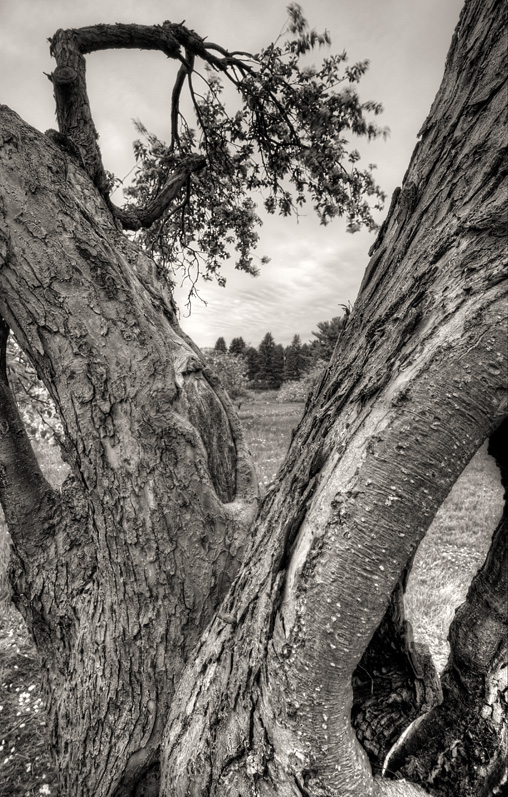
Old Cider - Stillwater, MN
Canon 5D mark iii + 17-40mm f4.0L & 3-stop B+W ND
We've adopted another puppy and with this comes the duality that accompanies every major decision. The fun of jostling a belly with stumpy legs is tempered by sleep deprivation and zero dark-thirty walks. The older dog, Sequoia, must endure the annoyance of puppy teeth in order to eventually have a worthy playmate. Dichotomies are at the root of so many of life's experiences. When we embrace the dichotomy we begin to see with greater clarity.

To produce this photograph I needed to balance my vision with the limits of my circumstance. The light was changing rapidly as heavy winds moved the clouds aloft. The streaky sky was quickly becoming overcast, and the tree I sought to photograph was trembling in the breeze. Rather than fight nature, I let the conditions dictate the process. I must have encircled the tree a dozen times before settling on this vantage point. The apple blossoms were in full bloom, but the wind foiled any attempt to make them my focus. The path of least resistance was to embrace the situation. It was here, before the composition was set, that I knew the image would be a black and white photograph. I added a 3-stop neutral density filter to my 17-40mm lens and zoomed to maximize the size and texture of the trunk. I waited for a massive gust of wind and shot a one-second exposure to capture the rustling of leaves. With windows facing into the apple orchard, I embraced the dichotomy and captured this familiar place in a new way. 


©2000-2013 BTLeventhal.com / Bruce & Tamy Leventhal. All rights reserved. No image on this site may be used without permission.

Sunday, April 21, 2013

Deep Knowledge

Wet Grizzly Bear (Ursus arctos horribilis) - Banff National Park, Canada
Canon 7D + Canon 300 f2.8L IS
Cliché warning.... the world wide web is the great equalizer. 
New information streams at a unattainable rate, so I resort to summary sources to fill the immense cognitive vacuum; born is the literate poser. Original works take too long to digest, are cluttered by their obtuse detail, and often mask the bottom line. A three hour investment on the source yields deep knowledge of minutia and little else. Science Daily and Science News are my crutch, I am a poser. 
Crane Lake - Lake Country, MN
Canon 7D + Tokina ATX-II 12-24mm f4.0
Today’s world of bits, bytes, and data create an opportunity for many while diluting greatness that might be lurking among the throngs of web participants. In the near past, it was easy to sort through the trash and find nuggets of gold. Outstanding works of art, literature and science seemed to radiate from within the pile, but today’s trash heap is so dense that the singularities are buried too deep to see.
Spring Crane (Grus canadensis) - Manning Trail, MN
Canon 40D + 
Canon 300 f2.8L IS + Canon 2x Converter Mk II
Like many, I am web junky. I frequent the usual sources like the NYTimes.com, Politco, HuffingtonPost, ScienceDaily, TechNews, and DPReview. Far from knowledgeable, I know a little about everything and a lot about nothing. Knowledge is good, but deep knowledge is better. In teaching biology, I find that my years of investment in the field, lectures, and labs are the platform for my classroom creativity. Deep knowledge serves me well when working with neophytes, but the farther I am removed from my formal training, the shallower I become. I try to leverage my losses with a voracious appetite for the ubiquitous glossy summaries available to us all... the web is the great equalizer for a homogenizing society.
Gondola Sunrise - Venice, Italy
Canon 5D Mk I + Canon 24-105 f4.0L IS
The context for my lament points directly towards my passion for seeing nature and being a participant in this world. The skills I developed with film are the foundation from which I now work the digital platform. Exemplary work, once relegated to the few willing to invest the sweat to learn, is now readily available to the masses. Like the world wide web, digital is the great equalizer. Average shooters become experts in months instead of years, and images that once took years to conceive are produced and shared freely every day. Deep knowledge serves us well when striving to be the best, but remedial skills coupled with amazing technology now makes fools gold glitter with brilliance.

©2000-2013 BTLeventhal.com / Bruce & Tamy Leventhal. All rights reserved. No image on this site may be used without permission. 

Thursday, March 7, 2013

Winter Diary (Post IV)

Fallen
The pattern caught my eye while photographing swans.
I realized that it was an oak leaf that persevered on a frozen lake.
Crazy that something so light could be etched into the winter's sediments of Snow.
Canon 5D Mark iii + Canon 300mm f2.8L IS

©2000-2013 BTLeventhal.com / Bruce & Tamy Leventhal. All rights reserved. No image on this site may be used without permission.

Sunday, February 24, 2013

The Butterfly Effect

Moon Tree Number II - Minnesota
Canon 5D mark II & Canon 50mm f1.4 USM
Most of my free time is spent at work, working on work or talking about work. My commitment to “the job” reflects the passion for the work I do. Twenty-one years later, I still believe that I can influence the future and make a real difference in the lives of the people I see each day. Teaching is one part insanity and one part naïveté. 

I am delusional because I believe that what I do each and every day really matters. It’s a crazy thought when you go to work with the assumption that what happens today makes a difference tomorrow. Some call it the “butterfly effect;” a sensitive dependence on initial conditions which assumes that a small perturbation will result in large-scale changes to a future state. 
Eastern-tailed blue butterfly ( Cupido comyntas ) - Wm Obrien State Park
Canon 5D mark I & Canon 100mm f2.8 USM
What is your motivation? If you work for the money, you will never know the pleasure in the work you do. My craft, photography, is not limited by the product. The picture is something to share, while the story in the image reflects the life that is lived. Like the work I do everyday, my art is my passion. Images are like the beat of wings in the still of the night that generate ripples in the air. Regardless of the stimulus, both will have unpredictable consequences. In this non-linear world where chaos rules, I choose to embrace the experience, and believe my actions can influence the future.

©2000-2013 BTLeventhal.com / Bruce & Tamy Leventhal. All rights reserved. No image on this site may be used without permission.

Wednesday, January 16, 2013

The Devil's in the Details

Medicine Lake - Jasper National Park, Canada
Canon 5D mark II + Canon 24mm f3.5L TSE
5-shot bracket - HDR
Geek alert... this post focuses on the digital techniques I used to produce the leading image. So, if you’re just interested in the picture, here are the liner notes... you are looking at the long view of Medicine Lake in Jasper National Park. The photo was captured around 4:00 p.m. on a summer day just as the light began to soften.

I wish this image was as easy to produce as it is to describe, but in practice, it required a lot more forethought. Tamy and I spent 16 days exploring the Canadian Rockies. During our travels, we focused on wildlife, flowers and landscapes. I had seen so many amazing images of Lake Louise, I knew that this was something I had to have for myself. After spending many early mornings and late evenings working the iridescent blues of Canada’s most famous lake, and getting the shot in “the can*,” Medicine Lake was next on my hit list. We visited the Medicine Lake area at least four times during our four-day shoot in Jasper, and each stop was more disappointing than the last. We’d arrive early and shoot the pre-dawn light and stay late into dusk, but we just couldn’t get the conditions that I had envisioned. My attempts were fraught with complications like overcast like, cloudless skies, or choppy water. During the final pass out of the Medicine Lake area, I impulsively stopped and dragged out the gear to make one last attempt. It took about 30 minutes to set up this shot, as I wanted to position the tripod as close to the ground as possible, level the horizon and build the composition. It was around 4:15 in the afternoon and, being a mid-summer day in Canada, the sun produced many deep shadows and bright highlights throughout. To counter this impossible situation, I produced a 5 stops series of bracketed images in order to capture all of the details from shadow to highlight.

In the initial edit, I was pretty disappointed with my Medicine Lake series. All of the images had serious flaws that I couldn’t see past, so I relegated the photos to my increasingly large pile of non-selects. Thus, a blog-post is born. I need something to say or something to share, and this challenge and frustration seemed as good as any idea I’ve had in the past. 

I pulled up my five shot series from Medicine Lake in Aperture 3.4.3, examined the histogram for each shot, and exported the files as tiffs into my “HDR folder.” In general, I am not overly fond of HDR (high dynamic range) images, and when using this technique, I lean towards the side of realism. The five shots were then imported into Photomatix Pro v4.2. Here I decided to “align the image according to features,” “reduce noise in shadows,” and “reduce chromatic aberration.” The program did it’s magic and spat out a cartooned version of what I had hoped to see.... this is why I generally dislike HDR! Rather than accepting the tone-mapped surreal product that greeted me, I used the program’s “Exposure Fusion,” option and began to tweak the black and white points. After adjusting the luminance and saturation, I saved the file and imported it into Photoshop CS5. In photoshop, I created a layer mask, adjusted the levels and then began to question whether the final image would be worth the effort. Looking at the post, I’m not sure that it is, and that’s why I think my process is worth these words in this blog. With the levels set, I created another layer mask where I adjusted the shadows and highlights. The global adjustments were over the top, so I painted back the dark tones except for the trees in the foreground. The use of the shadow tool often produces a flat image, so I needed to bump up the contrast. Because a global adjustment would wipe out the shadow mask I just made, I created another layer and used the Unsharp Mask tool at 20 sharpen, 80 radius, and 0 threshold to create some pop. The effect was overwhelming, so once again, I decided to “paint in” the contrast where it was needed. In a final step, I applied a minimal Smart Sharpening to the image and prepped the file for printing and web output. 

Post-processing is a necessary evil of the present. The film guy of the past would have taken the shot, edited the slide and tossed this image into the bin. The blown highlights and black shadows would have made for a lousy film shot. But hey, it’s 2013 and computers can do magic with troubling light. Digital now offers the opportunity for a hack like me to challenge my vision and capture a moment that I would have avoided in the past. Here’s to the “modern era!”
  • For you photo-noob’s, the phrase “in the can,” is a reference to film. Film, much like the LP, is ancient history. Film is a thin flexible piece of plastic or other material coated with a light-sensitive emulsion like silver halide. When you finish a roll, it goes in “the can,”... a metal or plastic film container ;-{> .

©2000-2013 BTLeventhal.com / Bruce & Tamy Leventhal. All rights reserved. No image on this site may be used without permission. 

Sunday, January 6, 2013

Fear and Inhibition

Finch Flight (Carduelis tristis) - Pasadena, CA
Canon 5D mark iii + Canon 300 f2.8L IS w/ Canon 1.4x Converter
This craft, photography, can be defined in so many ways. 
It is...
...a form of pure journalism when the photograph captures the “decisive moment,” a proverbial blip in time.
...a narrative, when the photograph tells a story about a place and time.
...a form of commerce, when the photograph captures its subject and portrays an ideal that can be bought and sold.
...a form of expression, when the photograph is a tool used by an artist to convey an idea or abstraction that resides within.
Sharks Love Popcorn - New York City Aquarium
Fuji X100
To the working stiff, this craft is a hobby, an outlet for the weekend warrior who is trapped by the constraints of life, career, and time. Yet we, the amateurs of the world, have the least to lose by taking a risk and still, we  tend to play it safe. We stay in our comfort zone rarely look beyond our strengths. 
Years Later at Ground Zero - New York City
Fuji X100
Guilty as charged, this is my modus operandi. I travel, document untouched ecosystems, avoid people and photograph large charismatic mammals. Shrouded behind a veil, I stay within my predefined limits and protect myself by hiding the experiments. Sadly, this is also a formula for quieting creativity, innovation and growth. My craft requires an adventuresome spirit and desire to take a risk, bug fear of acrimony or ridicule inhibits the urge. So here it is, the New Year and the requisite Resolution. 
Green and Gold (Carduelis tristis) - Pasadena California
Canon 5D mark iii + Canon 300 f2.8L IS w/ Canon 1.4x Converter
“I Bruce Leventhal will continue to push myself beyond my comfort zone, and I will share the experiments that I too often hide from my peers.”

©2000-2013 BTLeventhal.com / Bruce & Tamy Leventhal. All rights reserved. No image on this site may be used without permission. 

Friday, December 28, 2012

Reflections...

American Avocet (Recurvirostra americana) - Bolsa Chica Wildlife Refuge, CA
Canon 5D mark iii + Canon 300mm f2.8L IS w/ Canon 1.4x converter
No words... just an metaphor in the form of an image as one year comes to a close and another begins.

©2000-2012 BTLeventhal.com / Bruce & Tamy Leventhal. All rights reserved. No image on this site may be used without permission.


Sunday, December 23, 2012

The Day After

Stacked Rocks - Lake Superior, MN
Canon 5D mark ii + Canon 24mm f3.5L TSE
In the words of Edie Brickell “Drop me in the shallow water before I get too deep.” It’s another 5 degree morning, I’m buried knee deep in snow and the Mayan apocalypse was yesterday. Funny... I’m still here. As usual, the collective herd was wrong and I’m left with an empty feeling. 
Damn Trail - Redwood National Park
Canon 20D + Canon 15mm Fisheye Lens
I’m not sure what I was expecting. I’m not the apocalyptic type and tend to be a skeptic when it comes to anything fanciful. Yet, I couldn’t help imagine what it might be like if an apocalyptic event selectively eliminated this human virus. Hey, I’m grateful for the life that evolution has managed to send my way, but let’s face it... we are a paradoxical species that is wreaking havoc on the planet. Beings crafted from nature, we are one with the world, but our love affair with the planet’s bounty will likely be the source our demise. We kill just to watch it die, level mountains in search of shiny baubles and interfere with nearly every biogeochemical cycle. We are a wart that keeps getting bigger, and I fear that all that will remain of life’s diversity will be one giant wart!

Well, it’s December 22nd... and “it’s the end of the world as we know it, and I feel fine.”
... I think.
©2000-2012 BTLeventhal.com / Bruce & Tamy Leventhal. All rights reserved. No image on this site may be used without permission. 

Wednesday, December 12, 2012

Muse - Ardea herodias

Ardea herodias (Great blue heron) - St. Croix River
Canon 7D + Canon 300mm f2.8L IS

Muse; noun... Source of artistic inspiration. 
Derived from the nine mythological goddesses who symbolize the arts and sciences.

Here the word muse is used in a way that defies convention. Loosely interpreted, this elegant form is a muse that feeds my compulsion, challenges my vision and animates my craft. 

©2000-2012 BTLeventhal.com / Bruce & Tamy Leventhal. All rights reserved. No image on this site may be used without permission.

Sunday, December 9, 2012

Muse - Lake Superior

Driftwood - Gooseberry Falls State Park, MN
Canon 5D Mark ii + Canon 24mm f3.5L TSE Lens
I become increasingly restless as the confines of winter begin to close in. Diminishing daylight and long work days conspire to crush the creative spirit. This is the time that wanderlust fills the void. While holiday joy might inspire happiness for the masses, I can only see darkness. I'm not a family guy. I am a loner who loves the company of a few and seeks serenity when my mind becomes preoccupied with life's minutia. In these dark moments I need a muse, a subject that lacks the static nature of my predicament. 

Superior is this muse.The big lake releases a flood of emotion that I constrain each day. Its frigid wind and deep cold forces a cathartic release that inspires. No, it's not my only muse, it's just the one I need to visit each December.

For more from Gooseberry State Park, Check out this link to my "Favorite Places."  
©2000-2012 BTLeventhal.com / Bruce & Tamy Leventhal. All rights reserved. No image on this site may be used without permission.

Sunday, December 2, 2012

Tip #101: Fog, Smog and Overcast Light

Yellowstone National Park
Canon 5D mark ii + Canon 17-40mm f4L

You’ve traveled halfway around the world, woke up three hours before dawn and fought off cardiac arrest during your 6000 foot assent. What’s more, you broke the bank to take this trip and used all your vacation time just to capture an elusive target. Unfortunately, Murphy waved his ugly hand and the light is crap. Either the sun is too bright or you’re surrounded by a pervasive mist that will not go away. 
Lake Agnes - Banff National Park
Canon 5D mark ii + Canon 24mm f3.5L TSE
We’ve all been there and it’s these moments that test your patience and reward creativity. I have day job, so when I’m out on a shoot or traveling to photograph an ecosystem, I have to come back with something. It’s a cliche thing to say, but restrictions and limits feed my creative spirit. When faced with less than ideal shooting conditions, I put on my black and white goggles, study the landscape and look to play with tones and angles. During these less than ideal conditions, I work harder to define my story and be sure to pre-think the impact of every technical decision. Selecting the correct aperture, emphasizing shadows that define and choosing the right lens will be the difference between the images you cherish and those you can’t wait to forget. 
Icefields Parkway
Canon 40D + Canon 100-400 f4.5-5.6L IS
©2000-2012 BTLeventhal.com / Bruce & Tamy Leventhal. All rights reserved. No image on this site may be used without permission.

Monday, November 19, 2012

Tip #99: Make the Connection

Jasper National Park - Canada
Canon 5D mkII + Canon 50mm f1.4

There are fleeting moments where time stops and the essence that is the photographer becomes one with the subject. These are ephemeral experiences, intense bursts of focus that I can only describe as Zen. It might seem a contradiction for this empiricist to describe an experience in nature that is something less than science, yet I find that Zen philosophy can inform my mind without imbuing a religious conviction.
Eddy - Canada
Canon 5D mkII + Canon 24mm TSE f3.5L
Slot - Canada
Canon 5D mkII + Canon 50mm f1.4
Id, the scientist... “life is a continuum that began with a single cell competing for limited resources, motivated by the programmed need to replicate. Competition inspired organic innovation that led to a branching tree of life that extends into every ecological niche. Selection is the mechanism, and chance events in the environment separate the winners from the losers. The evidence of this rich evolutionary history is written in molecules and preserved in stone.”
Nanny and Kidd (Oreamnos americanus) - Canada
Canon 7D + Canon 300mm f2.8L IS + 1.4x converter
Leading Lines (Oreamnos americanus) - Canada
Canon 40D + Canon 100-400mm f4.5-5.6L IS
Zen, the artist... “Reality seems sterile and non-emotive. Art is a human pursuit, a mode of self-expression, and Zen helps me to explore my place in nature. I am the ripple in a pond, a wave in the ocean, a drop of rain cycling through the atmosphere; I am one, a part of the continuum.”
Reflecting Jasper - Canada
Canon 5D mkII + Canon 50mm f1.4
We are the Rock (Oreamnos americanus) - Canada
Canon 7D + Canon 300mm f2.8L IS + 1.4x converter
Schizophrenic in the literal sense, photography is a split of the mind; it is art and it is science. White light emanates from solar fusion, reflects off an earthly mass and photons are captured by a Silica wafer. Transformed into a binary code, this is the picture. In contrast, a careful search for leading lines, colored abstractions and tonal gradients shape our art. Lost in the moment, the photographer is one with the place and sees what others will not. Whatever your mind, accept that you are a part of the nature that you seek to capture, and you will make art from the science that is our reality.

©2000-2012 BTLeventhal.com / Bruce & Tamy Leventhal. All rights reserved. No image on this site may be used without permission.

Thursday, November 8, 2012

Tip #98: Rule #6

Black Bear and Dandelions - Jasper National Park, Canada
Canon 7D + Canon 300 f2.8L IS @ f2.8
Are you a working photographer or a photographer who works? If the title matters, then you really need Rule #6. Regardless of your profession, love of the process and the adventure should be motivation enough. Block the inputs that promote self-doubt or diminish the sense of worth. When you can't embrace what you enjoy, it's time remember Rule #6. 
Rule #6
Don't Take Yourself So @#&! Seriously
A Grasshopper's Nightmare - Jasper National Park, Canada
Canon 7D + Canon 300 f2.8L IS @ f3.2
©2000-2012 BTLeventhal.com / Bruce & Tamy Leventhal. All rights reserved. No image on this site may be used without permission.