Showing posts with label costa rica. Show all posts

Sunday, September 22, 2013

The Color of Costa Rica

Chestnut-mandibled Toucan (Ramphastos ambiguss swainsonii) - Hacienda Baru, Costa Rica
Canon 5D Mark III + Canon 300mm f2.8L IS + Canon 1.4x Converter
The Way We See It is on the move!
We have constructed a new gallery / website and blog where we will continue to discuss photography, travel, ecology, evolution and life in Minnesota. Please continue to follow us and our adventures at: http://btleventhal.com


©2000-2013 BTLeventhal.com / Bruce & Tamy Leventhal. All rights reserved. No image on this site may be used without permission. 

Sunday, August 25, 2013

What’s in a Blur (In Search of Creativity)

Green violetear hummingbird (Colibri thalassinus) - Savegre, Costa Rica
Canon 5D mark iii + Canon 300mm f2.8IS L + Canon 2x mark iii


I recently took a look at my neighbor / wedding photographer’s website (see http://brandonwerth.com) and thought to myself... “man that guy is so damn creative!” Being far removed from the portrait/wedding world, this type of photography seems as foreign to me as working with clay. 
Flying Monkey (Cebus capucinus) - Hacienda Baru, Costa Rica
Rather than art, I often describe my work as conservation photography or nature photojournalism. While I always strive to produce the best possible images, I know “creative” is not the first word that comes to mind. At times my work is technical, compelling or emotive, but the word creative is reserved for the artists of the world.
Lapa Lapa Lapa (Ara macao) - Rio Quatro, Costa Rica
To break my current photo-funk, I’ve been on the hunt for creative nature photographs. I know it when I see them, and sadly, this is not what I observe in most of my work. While searching for inspiring photographs of nature, I’ve found many self-described creatives and creativity in post-processing, but the real artists in my discipline seem far and few between. The well-known humanitarian and photo-educator David duChemin is at the precipice of creativity with his portraiture and recent works in nature, but the one I find most compelling is Nick Brandt. Call it retro, but Brandt continues to shoot large negative black & white film while the rest of us toil with our pixels and memory cards. The structure of his images are evocative and expressive in a way that few can extract from their nature and wildlife subjects. There is a depth and emptiness to his images, yet each is filled with the essence of its subject. I call this work creative because Brandt manages to combine the key moment with brilliant technical skills that makes for much more than a journalistic representation of time. I can stare at his pictures for hours.
Flying banana (Ramphastos swainsonii) - Hacienda Baru, Costa Rica
So, what’s with all the burry pics in the blog, you ask? 
During every prolonged shoot, I will break from my tendency towards technical perfection and try to escape from my self-imposed constraints. While I won’t be so bold to call any of these images creative, I might describe each as a purposeful attempt at making art from a bit of nature.

©2000-2013 BTLeventhal.com / Bruce & Tamy Leventhal. All rights reserved. No image on this site may be used without permission.   

Tuesday, August 20, 2013

Costa Rica 2013: My Ficus

The Strangler (Ficus insipida) - Hacienda Baru Wildlife Refuge, Costa Rica
Canon 5D mark iii + Canon 17-40L @ 19mm / f16
This giant of the secondary forest began its life after a clearcut, and has meandered its way towards the sky for the past forty years or so.  With buttresses that top out at six vertical feet and a girth of five man hugs, the tree shares all the characteristics of a typical mid-successional species. It’s a nutrient hog that is pre-programmed to strangle its elders in an attempt to fulfill a biological destiny. Much like the cottonwoods and tulip trees of North America, strangler figs (Ficus insipida) grow fast and large in a race to the top. Once there, they bask in the light of day and propagate effusively with a productivity that feeds a complex tropical web.

This particular ficus has been a favorite photographic subject. Located along a mangrove trail in the Hacienda Baru Wildlife Refuge, the fig tree is a landmark between the lodge and an egret rookery. I am drawn to the curvaceous buttress, asymmetric branches, and its largess. The challenge of capture is my muse. I dream of perfect light that is so rare below a rainforest canopy and am always forced to yield my preconceptions in search of a compromise between what is offered and what I can take. This tree has been pictured here in the past (see “Road-tripping Through Ecosystems #4) and I am certain that I will shoot and show it again. Ok... so it’s not really my ficus, but I wish it were. 

©2000-2013 BTLeventhal.com / Bruce & Tamy Leventhal. All rights reserved. No image on this site may be used without permission.

Sunday, August 11, 2013

Costa Rica 2013 - Painting with Light

Light Painting with Frogs (Agalychnis callidryas) - Selva Verde, Costa Rica
Canon 7D + Canon 100-400L IS @ 400mm
Exposure: ISO 200 : 6 seconds : f5.6
Used as a way to illuminate foregrounds without flash, light painting adds texture and dimension to star photography and nighttime portraiture. Less commonly applied to wildlife subjects, nocturnal animals are typically photographed with flash traps. While this technique can freeze the motion of an animal on the prowl, subjects caught in a trap often appear startled and unnatural. Additionally, because camera traps are challenging to focus, it’s important use small apertures that will increase the depth of field. The reliance on this technique results in pictures that seem to be littered by branches that reflect the cold and sterile light produced by a flash. 

While traveling through the tropics this July, we had the opportunity to do some light painting. Unlike the millisecond pop of a flash-trap, light painting relies on long exposures to soft light. To paint with light, you’ll need a friend or two to illuminate your nocturnal subject. To emulate the appearance of candle or firelight, we covered the bulbs of our dying flashlights with our hands and slowly moved the light near and around the frog. This type of light painting requires you to prefocus, and bump your iso to 400 or 800. I suggest that you use a stable tripod, mirror lock-up and a cable release in order to minimize camera movement. You’ll need to be prepared to experiment with duration of your shutter, take many pictures and stay up late! 

©2000-2013 BTLeventhal.com / Bruce & Tamy Leventhal. All rights reserved. No image on this site may be used without permission.

Sunday, August 4, 2013

Costa Rica 2013 - Nesting and the Importance of Perseverance

Adult Male Quetzal #2 - Savegre River, Costa Rica
Canon 5D mark iii and Canon 300mm f2.8IS L w/ Canon 2x mark iii converter
When asked how we find so much wildlife and produce so many unique pictures, my answer is unintentionally flippant. Simply put, our photographic outcomes are the product of practice and perseverance. We take many pictures, shoot most weekends, edit ruthlessly, and learn from our mistakes. After working all week to pay for the photography addiction, I look forward to sunrise Saturdays or Sundays with the intent of producing something new within the boundaries of my home range. This is the  practice; it is the investment we make that prepares us the fleeting moments. 

When traveling, we don’t travel like tourists. It’s not about seeing it all, it’s about making the most of the opportunity. We are “nesters.” We plan ahead, strategically select a few places to stay for extended periods, and we study the patterns in these novel locations.

We are patient and we persevere. After eight trips to Costa Rica, we have become more thoughtful and intentional when making pictures. Repetition is the key to our success. Rather than spray and pray, we’re on the trail early and make return visits to wildlife and landscape hotspots throughout the day. This type of forethought, patience and knowledge is attainable to those willing to nest. The longer we stay, the more we learn, and the greater our productivity. 
Adult Male Quetzal #2 - Savegre River, Costa Rica
Canon 5D mark iii and Canon 300mm f2.8IS L w/ Canon 2x mark iii converter
The quetzal images posted were produced because we knew how to use our gear, learned where the birds would feed, and invested the time to revisit a likely roost. While we photographed many individual quetzals during our prolonged visit to the Savegre Hotel, these two pictures were made as we departed lodge. Shot during our fifth and final day at this location, these images exemplify what is possible when you create the time to nest and are willing to persevere.

©2000-2013 BTLeventhal.com / Bruce & Tamy Leventhal. All rights reserved. No image on this site may be used without permission. 

Saturday, July 27, 2013

Where is your Shangri-La?

I Call it Shangri-La - Selva Verde Primary Forest, Costa Rica
Canon 5D Mark III + Canon 17-40mm f4.0L @ 19mm / f1
6
Synonymous with an earthly paradise, Shangri-La was first described by James Hilton in his 1933 novel Lost Horizon. The Himalayan utopia, as described by Hilton, lies trapped between mountainous peaks, and is a place where happiness and youth are maintained in perpetuity. 

I have seen Shangri-La. Hidden to most, this magical landscape reveals itself to those who embrace their wanderlust. A place where the land touches the sky and light scatters about, Shangri-La is only visible to the early risers, compulsive hikers, and the dreamers of the world. Located somewhere on this planet I’ve been there before and I have no doubt that I’ll be there again. 

Black & White Conversion with Topaz B&W Effects II

About the Picture --- This image was first conceived in 2011. I visited this valley during an intense hike through primary rainforest protected and owned by the Selva Verde Lodge and Preserve. Following an early morning ascent that included a precarious swinging bridge, hognose viper, steep switchbacks and bushwhacking up a mountainous slope, we arrived at the valley after sunrise. While I took many pictures that morning, I was forced to use HDR processing to reconstruct the image that disappeared as fast as the sun rose. 

We returned to the Selva Verde Lodge in July 2013. Knowing that my intended photo required us to beat the sun, we began our 2013 hike to Shangri-La at 5:00 a.m. On this day the atmospherics were kind as rain clouds hung in the valley while the sun climbed the mountainous slopes. With the sun to my right and thick clouds in the foreground, I decided to use this dying tree as a way anchor my landscape. While I like what I’ve produced, I still don’t think I’ve made “The Shot” that lingers in my mind... I guess this means I’ll have to make plans to return to this Central American Shangri-La.
  
©2000-2013 BTLeventhal.com / Bruce & Tamy Leventhal. All rights reserved. No image on this site may be used without permission.

Saturday, July 20, 2013

Costa Rica 2013 : Oophaga pumilio

I'll Take a Half Cup - Selva Verde, Costa Rica
Canon 5D Mark iii + Canon 300mm f2.8L IS + Canon 2x Mark iii Converter


What’s in a name? 
Known as the “strawberry, blue jeans, blastimentos, or la gruta” poison arrow frog, Oophaga pumilio is a frog with many names. Diminutive at about 20mm, Oophaga pumilio appear in 15-30 color morphs that vary according to their geographic distribution. Once considered members of the larger Dendrobates genus, the strawberry poison dart frog is classified in a single clade, Oophaga, whose evolution coincides with the formation of the Panamanian land bridge. 

Found from Nicaragua to Panama, each subpopulation is morphologically distinct. Some groups are bright red (strawberry) while others are yellow with black spots (la gruta). The frog pictured here is the “blue jeans” morph, and they are found throughout the Caribbean slope near the La Selva Biological Reserve in Costa Rica. 

The name “poison arrow” or “poison dart” is a generic reference to the poisonous neurotoxins that are secreted dorsally. Historically, pre-Columbian aboriginal populations used the secretions from living and dead frogs to produce poison darts that could be used to hunt monkeys and birds living throughout the forest canopy. In general, poison arrow frogs are unaggressive yet fearless. Dressed in neon and Day-Glo, this genus is famous for its aposomatic or “warning color” patterns. While there are a few bird species that can tolerate the toxins or modify frogs by scraping the glands on rocky surfaces, most birds use the outrageous colors as a way to recognize these frogs as non-food items. Observed in everything from insects to snakes, there is strong selective pressure for aposomatic warning patterns throughout tropical communities. So prevalent is this strategy, some non-poisonous species will mimic toxic ones by evolving aposomatic-like color patterns. 

The genus Oophaga is fitting, as the prefix “Oo,” egg, and suffix “phaga,” to eat, aptly describes the nutrition of the developing frog larvae. Female frogs carry eggs into the canopy and deposit them near a watery vessel. Often laid on the leaves of bromeliads, male frogs will make multiple visits to water the eggs and prevent desiccation. Once the tadpoles emerge, females will retrieve the larvae and carry the embryonic frogs to pools formed at the base of epiphytic bromeliads or tree cavity. Here, the larvae will grow until they develop legs and can leave their aquatic homes. The maternal ecological investment is high because the strawberry tadpole is a finicky eater. Beginning with the deposition of one to two larvae and every three days until final development, the adult female will return to the aquatic nest to lay unfertilized eggs. These eggs represent the entire diet of the Oophaga larvae until they can leave their watery home. The diversity and range of this species seems all the more incredible when you consider that less than 12% of all fertilized eggs the survive through metamorphosis. 

©2000-2013 BTLeventhal.com / Bruce & Tamy Leventhal. All rights reserved. No image on this site may be used without permission. 

Saturday, July 13, 2013

Costa Rica 2013 - In the Beginning...

A Window into a Monkey's World (Cebus capucinus) - Hacienda Baru, Costa Rica
Canon 5D Mark iii + Canon 300 f2.8L IS + Canon 1.4x Converter
After arriving at Juan Santamaria International airport in San Jose, we grabbed a taxi to the Hotel la Rosa de America in La Garita de Alajuela. Hotel la Rosa is a favorite bookend for my Costa Rica photo-adventures. Located in a quiet spot near the airport, La Rosa has beautifully manicured gardens that attract exotic blue-crowned motmot’s, rufous-naped wrens, and a variety of tanager species. However, la Rosa is just the beginning... we are now eight days into our travels and have seen more than can be shared at this time. Stay tuned, as there is much more to come! 


©2000-2013 BTLeventhal.com / Bruce & Tamy Leventhal. All rights reserved. No image on this site may be used without permission. 

Wednesday, July 3, 2013

Costa Rica 2013 : Pre-trip Post #3

Hognose Viper (Porthidium nasutum) - Selva Verde, Costa Rica 2011
Canon 40D + Canon 100-400 f4.5-5.6L IS
It's summer in North America and we're heading to the tropics. Constrained by a pre-defined school schedule, we rarely travel during spring and holiday breaks. In Costa Rica, these are the peak travel periods, and we can't afford peak rates, nor do we wish to endure peak tourist traffic. In the end, this winter retreat has become our summertime  oasis. With relatively few travelers competing for access to prime photographic locations, July and August is both affordable and productive months for those seeking some solitude in the tropics. 
Not Stuttering... Two Toucans (Ramphastos ambiguus swainsonii) - Selva Verde, Costa Rica 2011
Canon 7D + Canon 300mm f2.8L IS
Our batteries are charged and we've got memories to make and memory to burn. Follow us throughout the next few weeks as we explore the unimagined diversity of Costa Rica. 

©2000-2013 BTLeventhal.com / Bruce & Tamy Leventhal. All rights reserved. No image on this site may be used without permission.

Friday, June 21, 2013

Costa Rica 2013 : Pre-trip Post #2

Three-toed sloth (Bradypus variegatus) - Hacienda Baru, Costa Rica
Canon 40D + Canon 300mm f2.8L IS + Canon 2x converter 
This three-toed sloth was photographed in 2009 at the Hacienda Baru National Wildlife Refuge and Lodge. After days of looking for sloths on our own, we spent an afternoon with rainforest naturalist, Carlos Jimenez, searching for these omnipresent and elusive animals. We've discovered that nearly any basketball sized growth of fuzz looks like a sloth when staring into a forest canopy. Slow and deliberate, the hairy blobs are surprisingly challenging to find and photograph. While this image is far from perfect, it is among the best three-toed sloths we have on file. In 2013, we hope to have another opportunity to see and photograph these iconic symbols of the neotropics.


©2000-2013 BTLeventhal.com / Bruce & Tamy Leventhal. All rights reserved. No image on this site may be used without permission. 


Thursday, June 13, 2013

Costa Rica 2013 - Pre-trip Post #1

Mantled Howler Monkey (Alouatta palliata) - Sarapiqui, Costa Rica
Canon 7D + Canon 300mm f2.8L IS - 1/250 @ f/2.8 & iso 400 
Towards the beginning of July we'll be returning to Costa Rica for the eighth time. Although I have been fortunate to have safaried throughout East Africa and traveled across Alaska and Canada, I continue to find Costa Rica a compelling destination. Ever since the first trip in 1996, we always leave with the plan to return. 

During the next few weeks, I'll post a few archived images and share some photographic goals and plans for our forthcoming July adventure.

Pura Vida,
bruce


©2000-2013 BTLeventhal.com / Bruce & Tamy Leventhal. All rights reserved. No image on this site may be used without permission.

Saturday, March 23, 2013

Where is it?

Resplendent Quetzal (Pharomachrus mocinno costaricensis) - Savegre Mountain Hotel, Costa Rica
Canon 40D + Canon 300mm f2.8L IS + Canon 2x v1 Converter
Much like the desperation experienced during a futile search for cryptic wildlife, I am left with a burning question... where is it?  
Etched in permanent ink are the words "Vernal Equinox." I scribbled this in haste during the endless dark, two words that would make any scrabble player proud. In Minnesota, the Vernal Equinox signals the end of a cold Hell that only Dante could so eloquently describe. March 20th at 8:02 a.m. (cdt) 2013, the equinox, it came and then it went. I wanted to strip myself of winter's burden and dance naked in the glow of the sun, but I made a better choice. It was 6℉ (-14℃) when Spring sprung and three days later it is still damn cold. I've kept my clothes on and I've begun the hunt... I'm looking for Spring, it's lost and and needs to be returned. If you find it, please send me an email.

©2000-2013 BTLeventhal.com / Bruce & Tamy Leventhal. All rights reserved. No image on this site may be used without permission.


Sunday, November 25, 2012

Tip #100: Eat that Frog

Poison Dart (Dendrobates auratus) - Selva Verde, Costa Rica
Canon 40D + Canon 100 f2.8 Macro USM 
It’s your mountain of homework, bills that need to be paid or taxes you’ve neglected to file. Your frog is the ugly task you avoid each day, week, month and year. It is your anchor; a weight that drags you into the abyss. Your frog saps your creativity. It sits on your desk and croaks in your general direction. That frog needs to be eaten!
First Snow - Stillwater, MN
Canon 5D Mark ii + Canon 40mm f2.8 STM
Based on a book by Brian Tracy  and introduced to me via a podcast by Martin Bailey, the analogy really resonated with me. We all need to eat that frog now, because there will be two tomorrow and three the next day. It is important to recognize that we do the things we need to do so that we can do the things we want to do. If you eat that frog today, you’ll have more time for your craft tomorrow.  
Before First Snow - William Obrien State Park, MN
Canon 5D Mark ii + Canon 40mm f2.8 STM
Want to learn more about Brian Tracy’s book? Check out the link: http://www.youtube.com/watch?v=0W7GB5Fh2XM
Cope's Gray Tree Frog (Hyla chrysoscelis) - In the Garden, MN
Canon 5D Mark ii + Canon 100mm f2.8L IS Macro
©2000-2012 BTLeventhal.com / Bruce & Tamy Leventhal. All rights reserved. No image on this site may be used without permission.

Wednesday, October 24, 2012

Biodiversity

Tropical Deer - Odocoileus virginianus
Canon 300mm f2.8L IS
Wanting to break from reality, I'm diving into the archives in search of orphaned work. Trapped between travels and obligations for the "A" job, I need my past to see my future.  
Peanut Head - Fulgora laternaria
Canon 300mm f2.8L IS
Mantled Howler Monkey - Allouatta palliata
Canon 300mm f2.8L IS
Variegated squirrel - Sciurus variegatoides
Canon 300mm f2.8L IS
All images in this post are from Costa Rica. The pictures were shot in 2011 and they represent a fraction of what we saw that year. During the summer of 2013 we travel back for our 8th visit and are looking forward to enjoying the experience with good friends who share our passion for photography, biodiversity and the evolutionary process.


©2000-2012 BTLeventhal.com / Bruce & Tamy Leventhal. All rights reserved. No image on this site may be used without permission

Sunday, June 3, 2012

Tip #80: In Search of Simplicity

Widow Dragonfly (Libellula luctuosa) - Pine Point, MN
Canon 5D MarkII + Canon 100mm f2.8L Macro IS
As my worlds begin to collide, I now search for solitude and space. The split-personality that begins every September will soon merge into the “Me” I want to be. The bruce who was, is lost in the shuffle of expectation, obligation and responsibility. Students, polite with the newness and fear of their future, were respectful and dutiful. Nine months later, my act has grown tiresome and I am the used car man selling the unwanted wreck in a corner lot. A week stands between me and "Mr. L," it is a challenging time but I can see some light in a window at a distance.

Teak Shadow Dragonfly - Hacienda Baru, Costa Rica
Canon 5D MarkII + Canon 180mm f3.5L Macro 

On October 19, 2011 I embarked on what I call “Project 101.” This is my exercise, a personal journey to reflect on my own photographic process by offering a few ideas to stimulate yours. So as I struggle to grade a mountain of papers and motivate the unmotivated, I suggest that you search for some simplicity in your life. Take a walk with a camera in a quiet place, find a pattern that strikes a chord and contemplate the elegance in nature. 
I took a break from my mountain, I took a hike in the woods and I found the time to author this blog. Get out there and make some time to find yourself.
©2000-2012 BTLeventhal.com / Bruce & Tamy Leventhal. All rights reserved. No image on this site may be used without permission.

Sunday, May 6, 2012

Tip #72: High Key - Black & White

Young Capuchin (Cebus capucinus) - Hacienda Baru, Costa Rica
Canon 30D + Canon 70-200 f4L @ f4.0
When confronted with a shaded subject against a bright background, forget the highlights and shoot for a high key “glow.” Some animals live their lives in the trees, and unless you have access to a canopy blind, distracting highlights are unavoidable. While flash might be the equalizer, a burst of directional light might disrupt the subject and cast an unnatural tone across the image. On these occasions I live the light, accept the compromise, and expose for the subject.

For this image I chose to deal with the backlight and leave my flash in the bag. The inherent curiosity of the capuchin produced expressions that I feared a flash might alter. To capture the eye-eye perspective, I spot-metered the face, added a stop of light and purposefully blew the highlights. The raw image was converted to black & white in Aperture 3.2, while a red filter was used to accentuate the eyes. Throughout the years, I’ve discovered that I prefer to shoot within nature’s constraints, I love to be challenged by the unexpected, and would rather accept the light than impose my selfish goals on my wild subjects.
©2000-2012 BTLeventhal.com / Bruce & Tamy Leventhal. All rights reserved. No image on this site may be used without permission.

Sunday, April 29, 2012

Tip #70: Step Away From Yourself

Aquatic Flowers - Costa Rica
Canon 5D markII + Canon 180 f3.5L Macro @ f4.0
It is comforting to hide behind a false construct like “writer’s block” and “creative deficits.” At a moment of despair, we might claim to have lost the ability to be unique, to say something new, or to see differently. These, I fear, are simply excuses that reward our inherent desire to be lazy. 

Bamboo Orchid (Arundina bambusifolia) - Costa Rica
Canon 5D markII + Canon 180 f3.5L Macro @ f4.0

Nature Photo Tip #70 falls within the despair I have just described. I am tired after a long week of work, I am bored with my library of images, and I fear that I am losing my capacity to “see.” Does this sense of loss sound familiar to you? I experience these feelings regularly, and eventually break free from the self-doubt. Fortunately, research is on my side. While the crutch may be a comfortable one, writer’s block and creative lapses do not exist. What exists is the resistance to do the hard work of writing or being creative. It is not easy to write with clarity, to see differently, or to create something new. However, at the core of our humanity is a complex brain that continually invents and creates. New ideas from old unfold, twist about, and scream to be released. Yet, we are faced with the challenge of articulating this infinite creativity into something real... something that others can see.
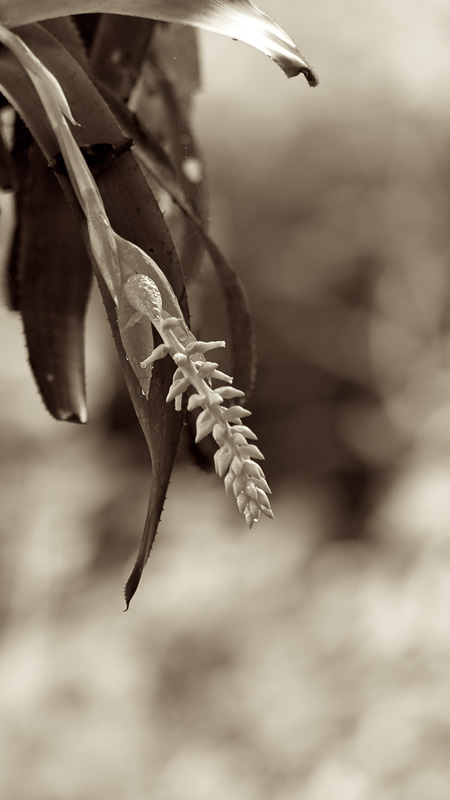
Sepia Bromeliad Bloom - Costa Rica
Canon 7D + Canon 300mm f2.8L IS @ f4.0
When I find myself mired in a creative funk, I work harder instead of less. I reflect on my past work and abandon it like a freed prisoner. I step away from myself and try something new. The images presented are departure from my norm. These are not my typical subjects nor do they reflect my signature image processing style. Don’t let yourself hide behind a false construct, there is no lapse of creativity. Step away from yourself and do the hard work.  
©2000-2012 BTLeventhal.com / Bruce & Tamy Leventhal. All rights reserved. No image on this site may be used without permission.

Sunday, April 1, 2012

Tip #62: Find a Friend

Morning on Baru Beach - Dominical, Costa Rica
Image by T. Leventhal - Canon 40D + 17-40L @ 17mm & f16


While I consider myself to be the solitary type, preferring the company of a rock to a conversational companion (see prior INTP post), I do relish the photo-adventures I take with my wife and partner. Although she is not the techno-geek that I profess to be, Tamy is the “Grape-nut girl” that works well with this “Grape-nut guy.” Often the first to suggest a new location or plan a road trip, she enjoys the field, working a new species or shooting an exciting landscape. There are days when we work side-by-side and others where there may be hours between conversations. Whatever the pattern, I find these experiences to be among the most fulfilling when traveling abroad.
Oophaga pumilio "Blue-jeans" Poison Dart - Selva Verde, Costa Rica
Image by T. Leventhal - Canon 40D + 100mm f2.8 Macro USM
A partner adds so much value to the shooting experience. They offer...
  • a different perspective in a common location.
  • the opportunity to have eyes in the back of your head.
  • the chance to get the ONE shot you missed.
  • an opportunity to download, review and discuss what comes next.
  • a chance learn something new or see differently. 
Velvet Elk (Cervus canadensis) - Yellowstone National Park, MO
Image by T. Leventhal - Canon 40D + 100-400L f4.5 IS @ 360mm
Bottom line, find a compatible shooting partner, hit the road and expand your vision.
Spring Falls in HDR - Osceola, WI
Image by B. Leventhal - Canon 5D markII + 17-40L @ 17mm & f16
My Friend Watched the Gear Bag as I wandered off to take this shot... always good to shoot with a friend!

©2000-2012 BTLeventhal.com / Bruce & Tamy Leventhal. All rights reserved. No image on this site may be used without permission.

Sunday, March 18, 2012

Tip #58: The Anthropomorphic Image

Something Stinks Around Here - Collard Peccary (javelina), Pecari tajacu
Canon 7D + Canon 300mm f2.8L IS + Canon 1.4x Converter
Saguaro NP, AZ


An·thro·po·mor·phic, adj: ascribing human characteristics to nonhuman things 
It is the “cardinal sin” of the sciences, especially in zoological and botanical disciplines that require pure objectivity. The anthropomorphic biologist fails to see the adaptive nature of a behavior, lacks a clinical assessment of an interaction and allows emotion to betray the implications of the data. I can still recall the red marks on my first undergraduate thesis. Years of research produced pages of data that were written by hand and analyzed with primitive computers. My experiment was controlled, the statistics were accurate and my conclusions were sound. However, the analysis in my discussion lacked the scientific approach that stressed objectivity above everything else. I was reprimanded and forced to write and rewrite the thesis until it was devoid of humanity. 
The Old Man - Savanna Elephant, Loxadonta africana
Canon 1D markII + Canon 300mm f2.8L IS + Canon 1.4x Converter
Serengeti National Park, Tanzania
Twenty-three years later, this aging biologist and educator is also a photographer. The scientific mind is the objective mind, while the high school educator is the master of anthropomorphism. Atoms want to embrace as they form chemical bonds, prey strive to avoid predation, and plants try to grow towards the light. Claiming that hydrogen is the “slut” of the atomic world to oxygen, the “player,” who does nothing but take-take-take in the pursuit of electrons, I console myself that these sins are for the greater good ... the education of the next generation.
Broken Jaw - Mantled Howler Monkey, Alouatta palliata
Canon 7D + Canon 300mm f2.8L IS
Selva Verde - Costa Rica
As in education, anthropomorphism is the wildlife photographer’s friend. It is human nature to see ourselves in nonhuman beings, as this is how we build meaning from what we observe. The technical skills of the nature photographer fulfills my scientific mind. The pursuit of the subject, the assessment of phenology and the research of behavior are my science, but my goal is to transcend the technical and find the hints of humanity in my prey. Anthropomorphic images allow the viewer to see their nature in nature, and suggest the importance of conservation. When pictures define humanity with the absence of humans, we help others to see ourselves as just another biological being. Tug at some heart strings, promote conservation and search for yourself in your subjects.
©2000-2012 BTLeventhal.com / Bruce & Tamy Leventhal. All rights reserved. No image on this site may be used without permission.

Sunday, February 26, 2012

Tip #53: Punish Your Pixels

Yellowstone Dawn - Yellowstone National Park
Enhanced Processing to Accentuate Color and Detail in Pre-dawn Light
Canon 5D MarkII + Canon 17-40L f4.0

This Week in Photo (TWiP) host, Frederick Van Johnson, likes to claim that “Pixels were meant to be punished.” Metaphorically, he argues that photographers should feel free to manipulate, distort and play with their digital images. For some this is heresy, while to others, it is art. The degree to which I manipulate a given image is dependent on the context. Whenever I wear my nature-photojournalist hat, I am a scientist. On these occasions, my goal is to illustrate the reality of a moment, capture a behavior or relate the character of an ecosystem. As a photojournalist it would be a breach of ethics if I were to do more than routine color correction and image sharpening. 
Here Comes the Sun - Selva Verde Reserve, Costa Rica
This is a 5 shot HDR-Processed Image. The Image Accentuates Color while Capturing the Details in the Shadow and Highlights
Canon 5D MarkII + Canon 15mm Fisheye

On the other hand, whenever I dawn the artist cap, I liberate myself from my scientific tendencies, and freely alter the character of my images. While I am not one to add new elements or remove objects that distract, I will push the limits of color, contrast and composition as a mode of self-expression. In truth, every photograph is a form of altered reality. The photographer’s choice of aperture and shutter defines the depth of detail and amount of motion, while choice of lens can be used to include, exclude or compress distant objects. Acclaimed for his unique ability to capture the essence of a place, Ansel Adams was the grand master of manipulation. Trashing color from a scene, defining the character of light and controlling contrast with chemistry are just a few of the many ways that he enhanced his images in the name of art.
So there it is, Tip # 53
Don’t be afraid to punish your pixels in pursuit of artistic expression.
©2000-2012 BTLeventhal.com / Bruce & Tamy Leventhal. All rights reserved. No image on this site may be used without permission.