Showing posts with label winter. Show all posts

Sunday, April 14, 2013

An April Diary

April 28, 2005
Canon 1D + Canon 200mm f2.8L @ f2.8
Average Temperature 45 ℉, No Precipitation
As winter yields to spring, the vernal equinox foreshadows an inevitable change. The long nights become long days, and the repressed are free to bask in the warmth of spring. 
April 5, 2008
Canon 1D mark ii + Canon 300mm f2.8L IS @ f2.8
Average Temperature 45 ℉, .1" mixed Precipitation

Having spent my adolescence on the west coast, I was not prepared for the schizophrenia that is April. In California, April is just another month of warm days and cool nights. The equinox was an irrelevant date on the calendar, and spring was cooler than summer. In contrast, the oppressor, winter, punishes the plebeians who reside in the middle of the continent. April is our reward for endurance, but we mid-continentals, are nothing more than April fools.
April 16, 2011
Canon 7D + Canon 300mm f2.8L IS @ f2.8
Average Temperature 35.8 ℉, .11" Precipitation
Today is April 14th, it snowed, hailed and rained all day. My income taxes are due tomorrow, and the high school prom I coordinate is on April 27th. My students now behave like caged rats, and the drive to work has more pocks, cracks and shifts than the San Andreas Fault. I hate April! April is the greatest fallacy there ever was. Spring is not relief from winter, spring is just winter after winter.
April 7, 2012
Canon 7D + Canon 300mm f2.8L IS @ f3.2
Average Temperature 50.3 ℉, No Precipitation
April is as schizophrenic as my rant; it is unpredictable, unforgiving and a wild ride. Every year I look forward to April’s migrations, buds and renewal and each time I am bewildered by its unpredictability. Who is this deviant we call April?... your guess is as good as mine.
April 14, 2013
Canon 5D mark iii + Canon 17-40mm f4.0L @ f14
34 ℉, Rain, Sleet Snow

©2000-2013 BTLeventhal.com / Bruce & Tamy Leventhal. All rights reserved. No image on this site may be used without permission. 

Sunday, April 7, 2013

Impressionism III

The Drake and The Swan (Anas platyrhyncos & Cygnus buccinator)
Canon 5D mark iii + Canon 300mm f2.8L IS

©2000-2013 BTLeventhal.com / Bruce & Tamy Leventhal. All rights reserved. No image on this site may be used without permission.

Saturday, March 23, 2013

Where is it?

Resplendent Quetzal (Pharomachrus mocinno costaricensis) - Savegre Mountain Hotel, Costa Rica
Canon 40D + Canon 300mm f2.8L IS + Canon 2x v1 Converter
Much like the desperation experienced during a futile search for cryptic wildlife, I am left with a burning question... where is it?  
Etched in permanent ink are the words "Vernal Equinox." I scribbled this in haste during the endless dark, two words that would make any scrabble player proud. In Minnesota, the Vernal Equinox signals the end of a cold Hell that only Dante could so eloquently describe. March 20th at 8:02 a.m. (cdt) 2013, the equinox, it came and then it went. I wanted to strip myself of winter's burden and dance naked in the glow of the sun, but I made a better choice. It was 6℉ (-14℃) when Spring sprung and three days later it is still damn cold. I've kept my clothes on and I've begun the hunt... I'm looking for Spring, it's lost and and needs to be returned. If you find it, please send me an email.

©2000-2013 BTLeventhal.com / Bruce & Tamy Leventhal. All rights reserved. No image on this site may be used without permission.


Sunday, March 10, 2013

Winter Diary (Post VII)

Feet First
Trumpeter swans (Cygnus buccinator) are an ideal subject for the winter naturalist.
White bodies contrasting with black extremities seem produce a form that seem
to captivate my imagination.

Canon 5D Mark III + Canon 300mm f2.8L IS
"Spring" break is over today, and with it ends this winter diary... The "A-Job" takes priority and pays the bills, so this blog will return to its weekly rant about travel, ecology, evolution or anything photographic that comes to mind...
Embrace the cold and shoot the winter, it's that rare treat that always comes too soon and leaves too fast.

©2000-2013 BTLeventhal.com / Bruce & Tamy Leventhal. All rights reserved. No image on this site may be used without permission.

Saturday, March 9, 2013

Winter Diary (Post VI)

North American Mink (Neovison vison)
This little guy was working itself silly hunting for crayfish through a maze of mallards.
Captured during my pursuit of its more aquatic cousins, this small
mustelid appeared after being skunked by otters
;-p

Canon 7D + Canon 100-400mm f4.5-5.6L IS
 
Mink #2 (Neovison vison)
Canon 40D + Canon 300mm f2.8L IS + Canon 1.4x Converter
©2000-2013 BTLeventhal.com / Bruce & Tamy Leventhal. All rights reserved. No image on this site may be used without permission.

Friday, March 8, 2013

Winter Diary (Post V)

Mallard Roost (Anas platyrhynchos)
Disappointed after an eagle spooked two otters, I wondered where the waterfowl went.
Found Them!
Canon 5D Mark III + Canon 300mm f2.8L IS

©2000-2013 BTLeventhal.com / Bruce & Tamy Leventhal. All rights reserved. No image on this site may be used without permission.

Thursday, March 7, 2013

Winter Diary (Post IV)

Fallen
The pattern caught my eye while photographing swans.
I realized that it was an oak leaf that persevered on a frozen lake.
Crazy that something so light could be etched into the winter's sediments of Snow.
Canon 5D Mark iii + Canon 300mm f2.8L IS

©2000-2013 BTLeventhal.com / Bruce & Tamy Leventhal. All rights reserved. No image on this site may be used without permission.

Wednesday, March 6, 2013

Winter Diary (Post III)

After the Owls
Shot on February 23, 2013 this photo was made as the sun was setting.
With nearly 500 miles on the Jeep we saw very few owls
but many amazing landscapes.
Canon 5D Mark iii + Canon 24mm f3.5L TSE

©2000-2013 BTLeventhal.com / Bruce & Tamy Leventhal. All rights reserved. No image on this site may be used without permission.

Tuesday, March 5, 2013

Winter Diary (Post II)

Trumpeter Swan (Cygnus buccinator) - Minnesota
Canon 5D Mark III + Canon 300mm f2.8L IS w/ Canon 1.4x vi
Many nature photographers and enthusiasts take a hiatus during the winter months. To be honest, I can't blame them. Years of shooting in the bitter cold takes its tole on the extremities. My fingers, toes and tip of my nose now fears the frost. It's hard not to question my own sanity, yet... I persevere. I console myself with the naive belief that I am unique in this craft and that few are willing to capture the harsh months like I do. 

In a few days I turn 48. As I approach 50, I am increasingly curious about how these experiences impact my longevity. Does the solitude during a winter shoot save me as many years as the cold takes away? I doubt I'll ever know, just like I doubt I'll ever stop. 

In my last post, Fool Me Twice, I shared a treasured experience with otters that emerged from an ephemeral break in the ice. During the next five posts I spare you my words and just share some of what I've seen this winter. It's been a good year so far, now I'm looking forward to what follows 47.  

©2000-2013 BTLeventhal.com / Bruce & Tamy Leventhal. All rights reserved. No image on this site may be used without permission.

Tuesday, February 12, 2013

Jekyll and Hyde

Stony Point in Black and White - Hwy 61 Scenic Drive, MN
Canon 5D Mark iii & Canon 24mm f3.5L TSE
A story about the stark contrast in one’s humanity, Dr. Jekyll and Mr. Hyde symbolize both the best and worst in any situation, moment or time. Say their names and the imagination runs wild. They are good and evil, Yin and Yang, light and dark all wrapped into a single package; he is the misguided man who wants it all. 
Owl Landscape (Aegolius funereus) - Hwy 61 Scenic Drive, MN
Canon 5D Mark iii & Canon 300mm f2.8L IS + Canon 1.4x Converter

February is Dr. Jekyll and Mr. Hyde. A time of stark contrasts where daylight grows and temperatures fall. Void of life, its leafless forests reveal the gems who hide in a summer’s shadow. The mass Exodus that began in August leaves the hardy behind, where survival is intimately linked to a well managed energy budget. 
Contrast - Hwy 61 Scenic Drive, MN
Canon 5D Mark iii & Canon 24mm f3.5L TSE
Yet the dearth that is February includes small nuggets of gold. One’s barren woods is another’s cornucopia. While resources are depleted to the north, ours are free for the taking and opportunistic migrants seeking easy food will see the Jekyll in my February’s Hyde. 
Boreal Owl (Aegolius funereus) - Hwy 61 Scenic Drive, MN
Canon 7D + Canon 100-400mm f4.5-5.6L IS
©2000-2013 BTLeventhal.com / Bruce & Tamy Leventhal. All rights reserved. No image on this site may be used without permission.

Thursday, February 7, 2013

Fowl Weather....

Winter Wood duck (Aix sponsa) - Vadnais Heights, MN
Canon 5D Mark iii + Canon 300 f2.8L IS on a 5 deg F Day
Just a few promised images produced on February 3, 2013. The product of "The Hammers," these pics were definitely worth the pain!
Agitated Drake (Anas platyrhynchos) - Vadnais Heights, MN
Canon 5D Mark iii + Canon 300 f2.8L IS on a 5 deg F Day

©2000-2013 BTLeventhal.com / Bruce & Tamy Leventhal. All rights reserved. No image on this site may be used without permission.

Monday, February 4, 2013

The Hammers

Summer Pronghorn (Antilocapra americana) - Badlands NP, South Dakota
The life of a mid-continental inhabitant wears on the psyche. Cold nights and cold days are our way of life. Sure I live south of the border, but it’s no party in Minnesota on a typical winter day. 

This Sunday past Tamy and I visited the “Swan Lake.” It was 5 ℉ when we departed the warmth of our home, and the temperature edged upwards to a whopping 7 ℉ after hours of photography. During the shoot, we both experienced “the hammers.” For those not in the know, “the hammers” are the mind-jarring pain that accompanies an intense exposure to the arctic air flowing across exposed extremities. So intense is this stimulus that I liken it to a mallet striking bare fingers and toes against an iron anvil.
Summer Day in Black and White - Badlands NP, South Dakota
I exclaim, “it’s unfair!,” The arctic air is no impediment to the fowl who winter at the lake. They bathe and tussle in the frigid water as if it were a hot tub on a summer day. We, the featherless, lack the down and plumage that repels the cold. With toes and fingers adapted to touch and fine motor coordination, our asset is now the enemy. Densely packed sensory receptors become overloaded by the intense cold stimulus and, unlike our feathered friends in their Turkish bath, we suffer. 
American Bison and Flower (Bison bison) - Badlands NP, South Dakota
There it is,... the REAL Life and Times of a Wildlife Photographer. To be honest, I’d love to show you some work from the shoot, but my hands are too cold to process the images. Once they thaw, I’ll post the shots... until then, enjoy this summer day at Badlands National Park.

©2000-2013 BTLeventhal.com / Bruce & Tamy Leventhal. All rights reserved. No image on this site may be used without permission. 
Wednesday, January 30, 2013

January 26, 2013

The Sculpture - Osceola, WI
Canon 5D Mark III + Canon 24mm f3.5L TSE
3-Shot Stitched Panorama
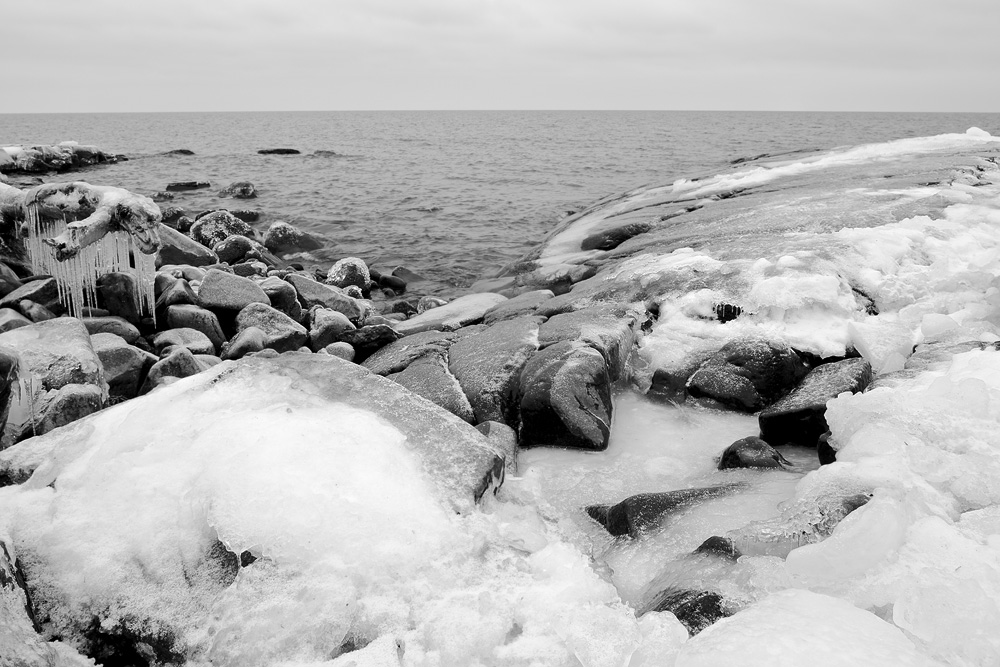
January 26th was another 14 degree morning. The crisp night turned water to stone, and a sculpture was left in its wake. Ephemeral as the day's weather, the ice evolves as warm air replaces cold. The artist, Winter, manipulates her medium with a frequency unlike any I have seen before. Her work is nothing short of a masterpiece, and I am lucky when I stumble upon her unique vision. 

©2000-2013 BTLeventhal.com / Bruce & Tamy Leventhal. All rights reserved. No image on this site may be used without permission.

Sunday, January 20, 2013

Celebration?

On Solid Water - Gooseberry State Park, MN
Canon 5D Mark III + Canon 100mm L Macro IS 
It was 41℉ (5 ℃) during yesterday’s commute. Less than 24 hours later, the temperature has plummeted 34 degrees. We now expect that tomorrow’s daytime high will be -17 ℉ (-27 ℃). 
Winter on Lake Superior - Grand Marais, MN
Canon 1D Mark II + Canon 17-40mmL @ 17mm

2012 was the warmest year on record in Minnesota, and January 2013 has continued the trend until now. Broad climatic shifts now seem to be the norm. A state known for its predictably cold winter now seems more like the moderate East Coast weather that I recall from my youth. While the current bitter temperature challenges my ability to expose, compose and shoot, it is a welcome change. Minnesota ice is back... and I hope that it sticks around for a while. 

©2000-2013 BTLeventhal.com / Bruce & Tamy Leventhal. All rights reserved. No image on this site may be used without permission.

Wednesday, January 9, 2013

Those Two Guys

Inbound (Cygnus buccinator) - Vadnais Heights, MN
Canon 5D Mark III + Canon 300mm f2.8L IS
This past Sunday I had the pleasure to do a bit of winter photography with my good friend Brian Collins. We first met at the Bell Museum in Minneapolis where we worked as naturalist/guides for the Bell's education program. Brian was working on his fisheries and wildlife degree, and I had just given up the life of a field ecologist to become a biology educator. Even back then, we both shared a passion for capturing the drama of nature and wildlife on film. To me, photography was the placebo that eased my transition from research to work, and to Brian it was a way to document the world he hoped to study. Shortly after graduate school, I moved on to a career in teaching, we lost touch, and that was that.
Preening (Cygnus buccinator) - Vadnais Heights, MN
Canon 5D Mark III + Canon 300mm f2.8L IS
Some might call it fate, I call it probability. There was no guarantee that we would bump into each other at Kohl's Department Store, nor that we might recognize one another five years later, but life's random nature and probability made for an unexpected reunion. The collision of our paths is now a distant memory, but ever since that day, we have remained great friends, photo-buddies, and sufferers of cold winter mornings.
Arousal (Cygnus buccinator) - Vadnais Heights, MN
Canon 5D Mark III + Canon 300mm f2.8L IS
So this past Sunday we ventured out on a frigid morning to catch a sunrise with trumpeter swans. Clear skies and cold air made for challenging photography, yet the swan activity kept us both engaged. Two guys pursuing a common craft and enjoying the still of a winter day may not be for everyone, but I could not imagine a better way to spend a weekend in January. To see more images of swans and other species that captivate the imagination, visit Brian's amazing photography blog at http://saintcroixbirds.blogspot.com.
Sometimes it's Better to be Lucky than Good (Cygnus buccinator) - Vadnais Heights, MN
Canon 5D Mark III + Canon 300mm f2.8L IS

©2000-2013 BTLeventhal.com / Bruce & Tamy Leventhal. All rights reserved. No image on this site may be used without permission


Thursday, May 17, 2012

Tip #75: Be Prepared with a Backup Plan

Mallard Drake at Sunset - Vadnais Heights, MN
Canon 7D + Canon 300mm f2.8L IS @ f2.8

I'm prepping for my upcoming "The Way We See It - Vision Quest" Workshop, so I only have time for a quick one today. As I pack the gear bag, dig out the projector and check my documents, I can't help but think about all of the things that have gone wrong in the past. 

  • I've brought the wrong cable
  • I've left the memory home
  • I've forgotten the flash manual
  • I've broken a charger
  • I've had a camera melt down
  • I've busted a ball head in baggage
  • I've broken the camera-bag zipper
  • I've forgotten my film (a long time ago)
  • I've lost the cable release
  • ... and the list goes on.
Today's tip... Have a backup plan...!
©2000-2012 BTLeventhal.com / Bruce & Tamy Leventhal. All rights reserved. No image on this site may be used without permission.

Sunday, March 4, 2012

Tip #55: Crop It!

Territorial (Trumpeter Swans: Cygnus buccinator)
Square Crop
Canon 7D + Canon 300mm f2.8IS L w/ Canon 1.4x Converter @ f5.6
Minnesota 
The title says is it all... 
Every camera and lens combination has the potential to enhance or constrain your vision. For example, the sensor in the typical digital SLR matches the 35mm format with its 3:2 framing ratio. In contrast, 4/3 (FT) and µ4/3 (MFT) cameras are defined by a smaller sensor with a 4:3 ratio. Prior to my transition to digital in 2003, I used medium format 645 and 6x6 cameras. I loved the large transparencies from these systems, especially the square images I produced with my classic Hasselblad.
Territorial (Trumpeter Swans: Cygnus buccinator)
Full Frame
Canon 7D + Canon 300mm f2.8IS L w/ Canon 1.4x Converter @ f5.6
Minnesota 
During a recent winter shoot, I had the opportunity to capture the drama of pre-mating rituals. Here the trumpeter swans had congregated in a patch of open water and were re-establishing pair bonds. Integral to this behavior is the the tussling between competitors as they define territorial boundaries. The top post demonstrates how a square crop emphasizes the size, behavior and action, where the 3:2 ratio includes benign elements that distract. While I am not an aggressive cropper, I believe that any crop that conveys your intent is not a crappy crop ;-)
©2000-2012 BTLeventhal.com / Bruce & Tamy Leventhal. All rights reserved. No image on this site may be used without permission.

Sunday, February 19, 2012

Tip #51: The Variable Neutral Density Filter

Winter Stream - Osceola, WI
Canon 5D MarkII + Zeiss ZE 35mm f2.0 @ f16 w/ Fader Variable ND Filter
The roots that compose the word for our craft, photography, are photo (light) and graph (picture). Absent from the prefix and suffix is mention of the camera, lens, sensor and resolution. While gear expands the possibilities and entertains our desire for things, it does not define the medium. As such, I have devoted very few words in this blog to discussions about photographic equipment. 
Frozen Falls - Osceola, WI
Canon 7D MarkII + Canon 300mm f2.8L IS @ f8
Master photographers perceive the way highlights enhance and shadows define. They recognize how the angle of inclination can alter a mood, and know that controlling a light's tone, duration and intensity conveys an intent. 
Winter Stream II - Osceola, WI
Canon 5D MarkII + Zeiss ZE 35mm f2.0 @ f16 w/ Fader Variable ND Filter
Light-picture - manipulate the light to convey your vision.
The variable neutral density (ND) filter is an inexpensive tool for controlling the amount of light that strikes the sensor. When attached to the front element of the lens, a rotation of this polarizer-like filter allows you to block 1 to 10-stops of light. These filters facilitate long exposure photography during daylight hours, thus allowing you to capture the blurred ebb and flow of cars, people and water during the brightest minutes of the day. A long-time tool of videographers and cinematographers, the variable ND permits access to fast apertures and slow shutter speeds when ambient light would otherwise restrict the exposure. Used here at Osceola Falls, my variable neutral density filter was attached to a 35mm lens. I set the gear on a stable tripod, used a cable-release and applied mirror lock-up to shoot a 20 second exposure at f16. 
©2000-2012 BTLeventhal.com / Bruce & Tamy Leventhal. All rights reserved. No image on this site may be used without permission.

Sunday, January 29, 2012

Tip #44: Go Manual...

Opuntia in Bloom - Badlands National Park, South Dakota
Canon 5D + Canon 100mm f2.8 USM Macro @ f7.1

Manual focus and manual exposure will slow you down. When you turn off the autopilot and assume the controls, you also create the opportunity to study the composition and think about the light. In the end, you’ll stop taking pictures and begin making images.
Winter Ice Cave - Osceola, WI
Canon 5D Mark II + Zeiss ZE 35mm f2.0 @ f22
©2000-2012 BTLeventhal.com / Bruce & Tamy Leventhal. All rights reserved. No image on this site may be used without permission.

Thursday, January 26, 2012

Tip #43: Add Light to White

Shades of White
Canon 5D MarkII + Canon 17-40mm f4.0L @ 17mm


It’s been a long and cold day. Frozen to the core you wait for the light, the mist rising above an icy river, or a fleeting moment that crosses your path. You bury yourself in the snow to create a natural hide or lie prone on the ice to frame a dramatic composition. Regardless of how you contort your body, wrestle with the tripod or endure the cold, your suffering is for naught if you can’t nail the exposure. 
White subjects on a bright background will appear to confuse the meter and confound the photographer. Knowing how your camera “perceives” the light is the key to making your white subjects white. 
Ice Falls
Canon 7D + Canon 300mm f2.8L IS
Our eyes see reflected light - radiant energy redirected from a subject onto the retina. This reflected light is the same light that strikes the camera meter. Unfortunately your camera lacks the brain you have, and cannot distinguish bright from dark, or highlight from shadow. In the place of a brain, the meter is calibrated to a standard.  The standard, middle gray (often incorrectly described as 18% gray), allows the photographer to predict the way light will be translated into the final image. What follows are three key concepts about reflected light striking the meter:
  • The meter averages the reflected light and suggests an exposure that makes your subject neutral (middle gray).
  • Because white is lighter than middle gray, your meter will suggest that you underexpose a white subject. If you underexpose white, the subject appears to be middle gray.
  • Because black is darker than middle gray, your meter will suggest that you overexpose a black subject. If you overexpose black, the subject appears to be middle gray.
Trumpeter Swan (Cygnus buccinator)
Canon 1D MarkII + Canon 300mm f2.8L IS
To make white subjects appear white, you must first realize that the meter suggests how to make them middle gray. This is the the moment of liberation, as once this is accepted as fact, your brain can define the correct exposure. When photographing white subjects, do the following:
  • Switch the camera to manual.
  • Fill your frame with the white subject or use your built-in spot meter to meter white. 
  • Choose the aperture and shutter speed that balances your exposure.
  • Now follow Tip #43 and Add Light to White... To do this, compensate for the middle gray calibration by adding 1 and 2/3 to 2 stops of light to whatever your meter suggests. 
  • For example... if the meter suggests that the “correct exposure” is a shutter speed of 1/500 second and aperture of f/5.6, you should change your shutter to 1/125 (that’s plus two stops...) at f/5.6. Alternatively, you can keep the shutter speed fixed at 1/500 second and change your aperture to f/2.8 (plus two stops). Either exposure adds two stops of light, and you will have added light to white.
©2000-2012 BTLeventhal.com / Bruce & Tamy Leventhal. All rights reserved. No image on this site may be used without permission.