Showing posts with label rainforest. Show all posts

Thursday, June 13, 2013

Costa Rica 2013 - Pre-trip Post #1

Mantled Howler Monkey (Alouatta palliata) - Sarapiqui, Costa Rica
Canon 7D + Canon 300mm f2.8L IS - 1/250 @ f/2.8 & iso 400 
Towards the beginning of July we'll be returning to Costa Rica for the eighth time. Although I have been fortunate to have safaried throughout East Africa and traveled across Alaska and Canada, I continue to find Costa Rica a compelling destination. Ever since the first trip in 1996, we always leave with the plan to return. 

During the next few weeks, I'll post a few archived images and share some photographic goals and plans for our forthcoming July adventure.

Pura Vida,
bruce


©2000-2013 BTLeventhal.com / Bruce & Tamy Leventhal. All rights reserved. No image on this site may be used without permission.

Sunday, May 6, 2012

Tip #72: High Key - Black & White

Young Capuchin (Cebus capucinus) - Hacienda Baru, Costa Rica
Canon 30D + Canon 70-200 f4L @ f4.0
When confronted with a shaded subject against a bright background, forget the highlights and shoot for a high key “glow.” Some animals live their lives in the trees, and unless you have access to a canopy blind, distracting highlights are unavoidable. While flash might be the equalizer, a burst of directional light might disrupt the subject and cast an unnatural tone across the image. On these occasions I live the light, accept the compromise, and expose for the subject.

For this image I chose to deal with the backlight and leave my flash in the bag. The inherent curiosity of the capuchin produced expressions that I feared a flash might alter. To capture the eye-eye perspective, I spot-metered the face, added a stop of light and purposefully blew the highlights. The raw image was converted to black & white in Aperture 3.2, while a red filter was used to accentuate the eyes. Throughout the years, I’ve discovered that I prefer to shoot within nature’s constraints, I love to be challenged by the unexpected, and would rather accept the light than impose my selfish goals on my wild subjects.
©2000-2012 BTLeventhal.com / Bruce & Tamy Leventhal. All rights reserved. No image on this site may be used without permission.

Sunday, April 29, 2012

Tip #70: Step Away From Yourself

Aquatic Flowers - Costa Rica
Canon 5D markII + Canon 180 f3.5L Macro @ f4.0
It is comforting to hide behind a false construct like “writer’s block” and “creative deficits.” At a moment of despair, we might claim to have lost the ability to be unique, to say something new, or to see differently. These, I fear, are simply excuses that reward our inherent desire to be lazy. 

Bamboo Orchid (Arundina bambusifolia) - Costa Rica
Canon 5D markII + Canon 180 f3.5L Macro @ f4.0

Nature Photo Tip #70 falls within the despair I have just described. I am tired after a long week of work, I am bored with my library of images, and I fear that I am losing my capacity to “see.” Does this sense of loss sound familiar to you? I experience these feelings regularly, and eventually break free from the self-doubt. Fortunately, research is on my side. While the crutch may be a comfortable one, writer’s block and creative lapses do not exist. What exists is the resistance to do the hard work of writing or being creative. It is not easy to write with clarity, to see differently, or to create something new. However, at the core of our humanity is a complex brain that continually invents and creates. New ideas from old unfold, twist about, and scream to be released. Yet, we are faced with the challenge of articulating this infinite creativity into something real... something that others can see.
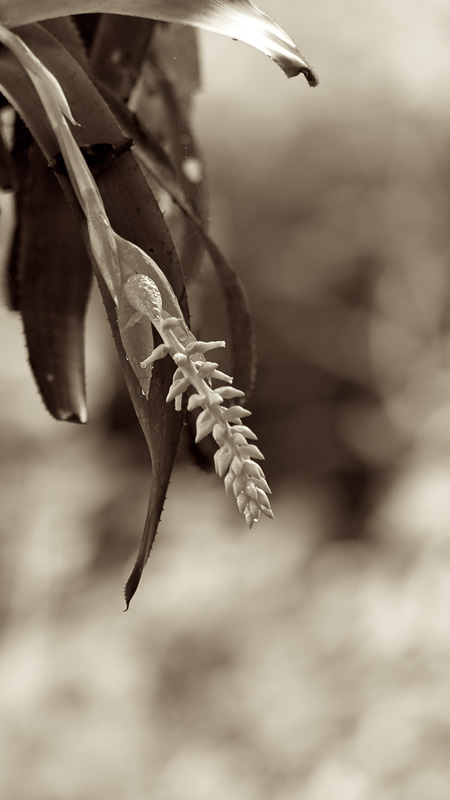
Sepia Bromeliad Bloom - Costa Rica
Canon 7D + Canon 300mm f2.8L IS @ f4.0
When I find myself mired in a creative funk, I work harder instead of less. I reflect on my past work and abandon it like a freed prisoner. I step away from myself and try something new. The images presented are departure from my norm. These are not my typical subjects nor do they reflect my signature image processing style. Don’t let yourself hide behind a false construct, there is no lapse of creativity. Step away from yourself and do the hard work.  
©2000-2012 BTLeventhal.com / Bruce & Tamy Leventhal. All rights reserved. No image on this site may be used without permission.

Saturday, July 16, 2011

Tropical Eye Candy

Shangri La Valley - Selva Verde, Costa Rica
Canon 5D MarkII + 15mm Fisheye - HDR Processing of three images @ +1, 0, -1 stop intervals
Our second day at Selva Verde began with an ass-whooping hike into the primary forest. We met our guide and friend, Michael Sevilla, at 5:30 a.m., shared a quick cup of café con leche, and crossed the Sarapiquí River. At first, the walk seemed somewhat pedestrian as we traversed the suspension bridge and hiked the river trail. Walking along the Sarapiquí, the birdsongs at first light was a chorus for the musical river that crashed along the rocky shore. Michael stopped at what appeared to be a random point, withdrew his machete, and hacked at a palm that was blocking the poorly worn path up the mountain. Barely awake and feeling the heat of a tropical morning, we began our ascent. It wasn't that the hike was particularly challenging, steep ...but not too bad; the disconcerting part of the journey was in the unknown. We had just swept a poisonous viper off the trail, and now we were hiking through thick vegetation. Our path was unmarked and seemed to be worn down by the feet of a peccary, coati, or some other small animal. We climbed higher, but I had no clue as to our final destination. Thorny vegetation, colorful palms, and spider webs slapped against my sweaty arms with each step into nothingness. At some point I turned to the rear and realized that Tamy and my sisters were gone. We all began as one, but now it was Michael and I. Sucking in the thick air, I yelled... "Marco...," and listened. "Polo, we're here..." So we continued the climb. All along, I couldn't help but think, "Where the hell are we going?!" I didn't dare ask the machete wielding man who had so kindly awakened on this Monday after Father's Day to take us on an adventure, but I couldn't help wonder "...would it be worth the hike?" Just as the doubt crept in, I gazed, breathlessly, into the valley. The sun was now peeking above the horizon, the thick virgin forest was to my back, and dew filled the landscape. This vista was my mornings' reward, this was my  'Shangri La.' 
©2000-2011 BTLeventhal.com / Bruce & Tamy Leventhal. All rights reserved. No image on this site may be used without permission.

Thursday, July 14, 2011

Fifteen Years Later

Red-eyed Tree Frog (Agalychnis callidryas) on Heliconia Flower - Selva Verde Lodge, Costa Rica
Canon 5D MarkII + 180 f3.5L - June 2011
Tamy and I made our first trip to Costa Rica in June 1996. A photo excursion to the tropics had been among our many travel dreams, and memories of this first visit continue to linger today. In preparation for this adventure to the rainforest, we viewed endless National Geographic videos, books about the Amazon, and watched the movie Medicine Man. If you've since forgotten or are too young to know, Sean Connery was the Medicine Man. He was the ecologist who famously propelled himself through the canopy in search of yet to be discovered drugs. Hoping to emulate his research methods, we spent a week in Rara Avis. This deep jungle eco-lodge is continuous with Braulio Carrillo National Park and only accessible by tractor. Rara Avis is the research facility and lodge where the "real" medicine man, Donald Perry, did his pioneering research on tree-top ecology. After four nights at Rara Avis, "the tractor from hell" dragged us down the mountain, and we headed towards the Selva Verde Lodge near the Sarapiqui River... 
Hognose Viper (Porthidium nasutum) - Selva Verde Lodge, Costa Rica
Canon 5D MarkII + 180 f3.5L - June 2011 


So here I am, fifteen years later recalling our first adventure to the tropics. Since that time, we've returned to Rara Avis, been to Costa Rica on six occasions, traveled to Africa twice, camped throughout Alaska, and road-tripped across the Californian and Washington Coasts. In all of our travels, we never planned a return trip to Selva Verde... that is, until Tamy said, " hey let's go back..." So we did. 
Blue Jeans (Dendrobates pumilio) Poison Dart Frog - Selva Verde Lodge, Costa Rica
Canon 5D MarkII + 180 f3.5L - June 2011
The images displayed are ones that we've always hoped to make. They are some of Costa Rica's signature species in soft light. All of these herps were found throughout the primary and secondary forests that are contiguous with the Selva Verde Lodge. During our most recent visit, I've rediscovered the beauty of the Caribbean Slope and realized the amazing insect, amphibian, and reptilian treasures waiting to be discovered. 
Red-eyed Tree Frog (Agalychnis callidryas) on a Wire - Selva Verde, Costa Rica
Canon 5D MarkII + 180 f3.5L - June 2011
Green & Black (Dendrobates auratus) in a Banana Flower - Selva Verde Lodge, Costa Rica
Canon 5D MarkII + 180 f3.5L, June 2011
©2000-2011 BTLeventhal.com / Bruce & Tamy Leventhal. All rights reserved. No image on this site may be used without permission.

Thursday, July 7, 2011

The One-Eyed Monkey


What does a one-eyed monkey and broken jaw have to do with natural selection? While I’m not sure I know the answer, I will venture the following hypothesis. However, before I explain, I feel the need to begin with the back-story…


So I’m thoroughly focused on a butterfly larva that looks like a snake’s head. The larva was perched on a large leaf displaying a scale-like pattern and false eyes. More bark than bite, its appearance is intended to be a threat that invokes fear. Since I’m no bird, I recognized the bluff to be an example of mimicry and proceeded to photograph the “sheep in wolf’s clothes.” With about thirty images in the tank, I began to hear the approach of howler monkeys crossing the river valley. The Sarapiquí River divides a patch of rainforest and acts as a natural barrier between two competing troops of monkeys. Hoots and howls from one side of the river inspire a nearby troop to respond. This type of vocalization is a declaration of territory and is a howler monkey’s way of saying… “don’t cross the line.” 

Monday, July 4, 2011

Species Profile: Megalopygidae

Biodiversity is the scientific way of describing variety; it is a measure of the total number of distinct species in a defined area. Some biologists assess biodiversity by examining genes within a population, while others invoke the classical “species concept” as a way of defining the richness of life in an ecosystem. Regardless of the measurement tool, high biodiversity is a good thing and is cited as a positive indicator for environmental health. 

Costa Rica and its tropical forests are known for its high species richness and biodiversity. Some regard the entire country as an ecological hotspot. With the Atlantic Ocean to the east and Pacific to the west, two distinct weather systems collide where the mountains bisect the country. Traveling east to west, the elevation increases along the Caribbean slope. The cumulative affect of oceanic air and elevation changes result in the formation of distinct microclimates that define multiple ecosystems within small patches of land. Like the Caribbean, the Pacific Slope is geologically diverse. As the mountains sink towards the ocean, the structure and diversity of the forests change. Geographic diversity and climate stability contribute to the staggering biological variety found across the country.

Wednesday, June 29, 2011

A Venomous Tale


The back story... 
A naturalist/guide was clearing a trail through a patch of virgin rainforest when the fangs penetrated his shirt. The viper's teeth sunk into his arm and inoculated the victim with a potent toxin. We were listening acutely to the story as Michael Sevilla led us across the suspension bridge and into the jungle. Call it a coincidence, but a hognosed pit-viper (Porthidium nasutum) now sits in a tight coil blocking our path through the forest. Michael, our photo-guide and naturalist, explained that his friend is in a hospital bed unsure of his fate. It took a while to transport the victim to the nearest emergency facility, and discussions about necrotic tissue and possible amputation ensued. Our viper is unfazed by our presence, and is unwilling to move. It's a small animal... less than a meter long, unglamorous, and well camouflaged. The reddish-brown color is broken by dark splotches that make this serpent cryptic in the understory of the forest. Unperturbed by our presence, the viper sat poised, coiled, and prepared to strike. Eventually, the extended leg of a tripod and repeated agitations had the desired affect. Unenthused by the relentless prodding, the snake slithered off the trail and into the leaf litter.


To produce this image I attached a Canon 180mm L-macro lens to my 5D Mark II and positioned the tripod in the same plane as the snake. The 180mm macro allows me to produce life-size images while maintaining a not threatening working distance. With the lens aperture set to f/4.5, there was enough depth of field to maintain sharpness across the head of the viper, while allowing the background to fall out of focus. 


Final note... during our last day at Selva Verde, we learned that Michael's friend has recovered from his altercation with the viper... no doubt he may a bit wary when it comes to snakes, be has survived and will likely be out hiking a forest trail in no time. 
©2000-2011 BTLeventhal.com / Bruce & Tamy Leventhal. All rights reserved. No image on this site may be used without permission.

Sunday, June 26, 2011

Bird on a Wire

"Bird on a Wire..." 
curiosity about this idiom led me to a google search for meaning. I found references to the 1968 Leonard Cohen song, but this didn't not match my graphic interpretation of the phrase. To me, a "bird on a wire" is a service animal employed by some Southeast Asian cultures when fishing. Quite literally, the bird on a wire is a hungry cormorant forced into indentured servitude. The captor places a noose around the servant's neck, and sends it into a lake to hunt. Instinct and hunger motivate the cormorant, and success is a fleeting experience. Once a fish has been trapped in the gullet of the bird, the fisherman reels in the servant, tightens the noose, and expels reward. Hunger motivates the servant, instinct drives the behavior, and success, normally adaptive, now lacks the positive reinforcement.


"Bird on a Wire..." a male and female cherrie's tanager (Ramphocelus costaricensis) perched on a support line at Hacienda Baru. Also known as the orange-rumped tanager, this relatively common bird can be found from the coastal plains to an altitude of 1700m. Though ubiquitous wherever there are ecological edges, gardens, and pastures this species continues to be an elusive subject for me to capture. Seven trips to Costa Rica, and this is the best tanager image that I've managed to produce. I comically call this species my nemesis, and have spent many morning hours chasing it around the gardens and edges of ecolodges. To produce this image, I mounted my 300 f2.8IS to a 7D, set the camera to aperture priority (AV mode), and set my exposure compensation to -2/3 stops. After much flittering about, the pair settled on the wire for about a second and I managed to catch this moment. I would have preferred an image on foliage, but the lines and out of focus background work for me. 


These birds on a wire are a metaphor for me. Much like the cormorant, hunger and instinct motivate my behavior. I cannot help but chase the moment. I am driven to produce images, and with each success, I am also met with failure. I have made the shot... it looks good, but it is not perfect... 
The fish is in my gullet, but I am not allowed to eat!
©2000-2011 BTLeventhal.com / Bruce & Tamy Leventhal. All rights reserved. No image on this site may be used without permission.

Wednesday, June 22, 2011

Greetings from Costa Rica

We are currently traipsing around the Costa Rican country side. Every time I visit this lovely tropical paradise, I can't help but think... "Must Never Leave!" While Costa Rica continues to develop economically as industry and tourism expands, the people seem as warm and friendly as ever. More about the people, the photography, and the environment when we get stateside. 
Pura Vida!
©2000-2011 BTLeventhal.com / Bruce & Tamy Leventhal. All rights reserved. No image on this site may be used without permission.

Wednesday, May 18, 2011

Rainforest in Black and White #2

Baru Beach, Hacienda Baru
Canon 40D + 17-40L


With our return trip to Costa Rica only 30 days into the future, I have decided to review past work and reflect on how I can make the familiar fresh. I love to shoot the rainforest, but am forever challenged by the streaky light, bright canopy, and the omnipresent shade of green. You'd think this cornucopia of biodiversity would make wildlife photography easy, but nothing could be farther from reality. The cryptic and shy creatures that inhabit a tropical jungle are invisible to those who know where to look and how to see. It is their "cloak of invisibility" that adds to the great challenge of rainforest photography.

Thursday, May 5, 2011

Rainforest in Black and White #1

Cecropia Flower in Black and White
Hacienda Baru, Costa Rica
Canon 40D + 100 f2.8 USM Macro
Sometimes its the little things that catch my eye, draw me in, and give me pause for thought. In this case, it was a spent flower. The pollen was transferred, the ovum fertilized, and the remains left to rot. Such is the way in nature. An elegant flowers advertises it receptivity, attracts the pollinator, and withers away. This balance between the need to reproduce and the dowry paid to a facilitator is elegantly displayed across the planet. Here, it is a little flower produced by a cecropia tree where the forest intersects with a meadow.
©2000-2011 BTLeventhal.com / Bruce & Tamy Leventhal. All rights reserved. No image on this site may be used without permission

Friday, February 25, 2011

Inspiration #1: Green Out

I am a carpool of one and live with the guilt of burning fuel on my twenty-two mile trek to and from work each day. Lacking a partner with the flexibility to adapt to my unpredictable work schedule, I carpool with National Public Radio. During this morning's commute the local climatologist offered the radio audience his word of the day... "green-out." 
There was a pregnant pause between his words and the definition that followed. Green-out... I thought to myself... what could this mean? Was a green-out an ugly temperature inversion that occurs during the depths of winter? No,... I've never seen a green inversion. Seconds later Mark Seeley offered the inspiration that I was seeking on this morning. 
Green-out... the first green foliage exposed following an arctic thaw. 
I thought to myself,... I want to trade the current white-out for a green-out. I want to see the green grass exposed beneath the melting snow. I want to shed the winter blues for summer greens. 
Today's post is Inspiration #1... The Cloud Forest of Savegre River. As a direct challenge to "Old-Man Winter," I will post nothing but green for the next seven days... I may continue to shoot the white and sterile landscape this winter, but I will dig deep in my memories and remind myself that spring is on its way.
Cloud Forest: Quetzal National Parque, Costa Rica. Canon 40D, 300mm f2.8IS @ f11
©2000-2011 BTLeventhal.com / Bruce & Tamy Leventhal. All rights reserved. No image on this site may be used without permission 

Monday, March 8, 2010

Dreaming of Cloud Forests


Stuck in a creative void and feeling too tired to contrive novel thoughts, I’ll let the images do the talking.

These two pictures were shot within the cloud-forests that includes Cerro de la Muerte and Quetzal National Park. This less traveled montane forest is home to unique endemic birds like the silky fly-catcher, ochraceous pewee, and resplendent quetzal.


©2000-2010 BTLeventhal.com / Bruce & Tamy Leventhal. All rights reserved. No image on this site may be used without permission

Thursday, June 18, 2009

Costa Rica 2009: A Good Guide


In general, Tamy and I try to go it alone. 
During a typical nature photog shoot, we stuff our photo packs, grab the tripods, and go for a walk. It is in the walking that we do the finding. While we often set some arbitrary distance or final destination, by walking we create the time and opportunity to see. On occasion we have hauled our gear up mountains, across rivers, and through deserts without taking a single photograph. In contrast, we have been to places where we are paralyzed by the infinite potential to see something new. We will walk ten feet, shoot for an hour, and move ten feet down the trail just to shoot again. When this occurs, we’ve hit the “mother load.”

Costa Rica is the “mother load” for photographic opportunities. Short walks offer an endless potential to see, find, and create. While visiting the Savegre Mountain Hotelin the Talamanca Range we were able to immerse ourselves in this rich ecosystem. The Savegre River and Mountain Hotel are at an elevation of 2200 meters (7200 feet) and reside in a valley below the stunted forests of Cerro de la Muerte. The elevation and persistent precipitation result in a cool climate that allows the humid atmosphere to condense and enshroud the forest in fog. Known as a cloudforest, this type of rainforest is rare and results in many unique species. Costa Rica’s cloud forest is rich with endemic species of hummingbirds, warblers, trogans, and tanangers. One spectacular bird species found in the cloudforest is the Resplendent Quetzal. With iridescent green and red feathers, this bird is among the most beautiful I have had the opportunity to see and photograph.

So, how does the walking photographer who is immersed in all things find a hidden jewel? 
Answer: Hire a wildlife guide. 
Marino Chacón, wildlife guide and co-owner of the Savegre Mountain Hotel, pulled up a chair during lunch and asked, “what do you want to see.” From that moment and until the day we left, Marino was our man. He guided us through a virgin oak forest, down the Savegre River, and to the resplendent quetzal. As a photographer and traveler, your time is limited; a quality guide is worth the fee and should tipped handsomely. Great guides live where they work, have studied your subject’s behavior, and can predict where and when the opportunities exist. Furthermore, great guides know and understand light. They will know when the light is good and when it is time to move on. Without Marino’s assistance, we would been paralyzed by the infinite possibilities. While we might have produced other striking images, we would have missed the unknown potential that lied just a few feet ahead.
Thank you Marino!

©2000-2010 BTLeventhal.com / Bruce & Tamy Leventhal. All rights reserved. No image on this site may be used without permission

Wednesday, June 17, 2009

Costa Rica 2009: The Vision Thing


Many nature photographers are specialists. The macro shooter invests in multiple macro lenses, remote flash triggers, and all sorts of reflectors and diffusers. The bird shooters look like they should be taking pictures in a football stadium, while others dress in camouflage and look like they are going on a hunting expedition. These bird specialists carry 500mm, 600mm, or even 800mm lenses. Some shooters are so into birds that they carry multiple super-telephotos into the field just to capture that elusive warbler, vireo, or tananger. In contrast to the bird photographer, the landscape wonk has a bag full of tilt-shift (TS) lenses and a 20+ megapixel camera, yet others are shooting large format film bodies. The best landscape photographers are the most devoted and patient people I have ever met. The landscaper will scout an area the evening before a shoot, get up at 4:00 a.m., and set up the shot for only a few exposures. They’ll get the one moment they wanted and be done for the day.

That’s a snapshot of the specialist, and none of them are me. 
I’m a nature generalist. I’m a biologist. I’m an ecologist. I’m into patterns, shifting light, animal behavior, and nearly any landscape. I don’t want to be tied to a schedule or specific location. I want to walk. I want to shoot a fern one minute and a monkey the next. I’m pensive with my composition, patient with my subject, but I’m always looking for the next picture. As a result, I’m not a great photographer, shit, I’m not even sure that I’m a good photographer. However, I do have a vision, and I do have a plan. I want people to see the things they don’t see. I want to freeze time while offering insight into the future. I want to hold my subjects so that my audience will pause. I don’t just want the shot, I want the shot that makes you stop and think.

©2000-2010 BTLeventhal.com / Bruce & Tamy Leventhal. All rights reserved. No image on this site may be used without permission

Costa Rica 2009: Ascent to the Cloudforest


After spending six days in the humid Pacific lowlands, we packed up the Suzuki Jimneyand, with much regret, said adiós to our new friends at Hacienda Baru. Leaving Baru, we drove south towards Dominical and veered east onto the Interamerican Hwy. Surprisingly, the road up the mountains and towards San Isidro was a refreshing departure from the potholes and oncoming truck traffic we endured during the first leg of our journey. 

The drive to Los Quetzales National Park and the Savegre Mountain Hotel was a dramatic ascent that took us through sleepy little villages and indigenous territories. With the exception of the occasional farm, the landscape was rugged and wild. The drive meandered through thick unspoiled forests that teamed with wildlife. The stretch of highway we drove is called Cerro de la Muerte or “Mountain of Death.” The unprotected shoulders that dip hundreds of feet into rainforest valleys and narrow bridges might lead you to believe that the road was named for the car accidents that frequently occur, however, Cerro de la Muerte describes the challenges indigenous peoples and early settlers faced as they attempted to traverse these mountains between the central valley and Pacific coast.

The forests along the Interamerican Hwy. undergo dramatic changes as the peak of the mountains approach. With increasing elevation the vegetation decreases in its girth and height. The peak is home to a stunted cloudforest with ancient trees that reach the diminutive height of two meters. High elevation and strong winds influence the growth of these ancients, the result is a surreal bonsai forest.

The rain pounded our vehicle as we began our descent into the valley. I had to make an abrupt left across the highway onto a single lane road that curved into the fog. The road to the Savegre River was the steepest I have ever experienced. Uphill traffic has the right of way, but I have no idea where I might have pulled over... mountain to the right and air to the left. Fortunately we didn’t encounter another vehicle during our 40 minute drop into the valley floor.

The Savegre Mountain Hotel and surrounding Quetzal National Park lies within this mountain range that creates a unique microclimate known as a cloudforest... more on that soon...

©2000-2010 BTLeventhal.com / Bruce & Tamy Leventhal. All rights reserved. No image on this site may be used without permission

Tuesday, June 16, 2009

Costa Rica 2009: Doesn't this Forest have any Sloths?


Sloths are a medium sized mammal that inhabit the rainforests of Central and South America. These famously slow animals are members of the Order Pilosa, a group that also includes the anteaters and the armadillos. Like most other members of the Order, sloths possess a fused spine, small brains, and small peg-like teeth. The characteristically slow movement and prolonged sleep patterns is an adaptation to the sloth’s uniquely low metabolic rate. Canopy leaves are the primary food that sloths consume. While sloths are technically omnivores due to the occasional consumption of insects and lizards, the mostly leafy diet takes time to digest and is generally nutrient poor. To compensate for the low energy diet, sloths expend little energy throughout the day and are thus a model for energy conservation. 

There are six extant (living) species of sloths that can be divided into two families according to the number of digits on their forelimbs. Commonly known as two-toed and three-toed sloths, these families apparently diverged from each other 35-40 million years ago. DNA and anatomical evidence now suggests that the two-toed sloth is more closely related to a now extinct ground sloth than to its contemporary three-toed arboreal “cousins.”  

Two species of sloths can be found throughout the rainforests of Costa Rica. The Brown-throated Three-toed Sloth (see above) and Hoffman’s Two-toed Sloth (see below) often overlap in their habitat and can be found surprisingly close to each other. The sloths at Hacienda Baru have been found in at least 40 different tree species and are likely to be consumers of the leaves in each of the host tree. The sloths in this region have been observed sleeping (or not moving) for 10 to 17 hours each day. However when they do move, the sloths have been observed moving vertically through the canopy as a way to regulate their body temperature. As a result, the sloths are often found in the mid-canopy at noon to avoid the heat of the midday sun or nestled towards the top of the canopy at night. 

I like to think of myself as a fairly competent naturalist who is capable of finding my own wildlife subjects to photograph. Relying on my prior Costa Rican experiences and finely tuned wildlife-seeking skills, we set out each morning and afternoon in search of a sloth. We knew the sloths were near, but they are crafty little creatures. Sloths have keen skills that include inactivity, sleep and camouflage. Fortunately for us, Jack Ewing, the manager and owner at Hacienda Baru recognized our dilemma and found a guide who would be able to find the elusive sloth. It took Carlos, less than ten minutes to find the first sloth, a sleepy two-toed ball of moss crammed into the fork of a tree. By the end of our sixty minute hike through a transitional forest we were able to observe four different individuals. 

The images pictured below are examples of a two-toed and three-toed sloth. To capture these images we had to shoot at a steep angle into the forest canopy. This type of photography is particularly challenging because it is difficult to expose for details in the animal while preventing a over exposed (white) sky.

©2000-2010 BTLeventhal.com / Bruce & Tamy Leventhal. All rights reserved. No image on this site may be used without permission

Monday, June 15, 2009

Costa Rica 2009: Lost in Paradise


Apparently I am becoming increasingly forgetful. While this is not a news flash to anyone who knows me, I sincerely hope that this little quirk is a characteristic that endears me to my friends and family. Unfortunately, my forgetfulness is becoming a bit of a liability.

We finally arrived at the beach following a monkey encounter on a steamy rainforest trail. Invigorated by the good photographic moment, we decided to shoot a few landscapes and hike the beach to the Baru River. The hike from the trail end to the Baru River is only 2.5 km, so we figured we could get some exercise while pursuing some new images. 

The playa (beach) in this region Costa Rica’s Pacific Coast is remarkable for its lack of development. The rainforest kisses the water for miles to the north and south, and it is easy to fall in love with the loneliness of the landscape. It is a rare thing to find a tropical beach that is not packed with tourist shops, hotels, and exclusive housing developments, so the beach at Baru is as close to perfect as it gets.

It was approaching midday as we traversed the beach sand, and the driftwood on the shore looked like a great place to rest for a while. My feet were tired and  Tamy looked like she wanted to take a beach nap. It took us about an hour to get to this cozy little spot, and I could see the mouth of the Baru River in the distance. It was a moment filled with cliches. A cowboy galloped by us on his white stallion, three locals were fishing in the distance, and we were living time on a desolate beach with the pacific to the west and unspoiled forests to the right,... paradise.

An hour later we decided to forgo our walk to the Baru River, as it was past noon and we were both getting hungry. So we began the return trip to the trail that would lead us back to the Hacienda Baru. It was so hot and humid that you couldn’t help feeling the clothes on your body. There is nothing like wearing clothes and thinking, “man these clothes... I can’t stop feeling them.” So in a futile attempt to ignore the climate, our hunger, and fatigue, Tamy and I became quite intrigued by the little red crabs that would scurry along the beach. These were magic crabs. Running on eight of their ten legs, these little crabbies would run about and then dive into holes that looked to be two sizes too small for their wide bodies. Time really flies when your watching red magic crabs.

I’m not sure where we were, but I forced a stop in our momentum to shoot the sky reflecting off the wet beach sand (see opening image). It was here that Tamy found a makeshift bench of driftwood and stones in the shade of an almandros tree. She read while I worked on my composition. When I finished, I packed up so we could move on... we had to be close to the trailhead by now. I was looking for a forked stick that was shoved in the sand; this was our landmark. Tamy indicated that there was a road and a sign where she had been reading, but I hadn’t seen the forked stick, so at the time, this bit of data seemed trivial.

When we passed the beached tractor tire and approached a mountain ridge that once appeared to be in the distance, I knew that we missed the trail head. It was an hour since I shot the landscape, the sun was intense, and I could see the strain of the heat on my wife’s face. Neither of us panicked, but we knew we were lost. Dehydration and sunstroke was not a part of our plan on this day. We broke open our last water bottle and sipped it slowly and carefully and reversed trek towards the river we left over two hours ago.

On occasion a dirt road would run parallel to the beach in the forest, this made the hiking easier and shaded us from the sun. Alternating between the beach, the road, and tall grasses we made it back to point where we stopped to make the photo at the top of the page. This is where I decided to read the sign: “HACIENDA BARU”

We weren’t really lost in paradise.

©2000-2010 BTLeventhal.com / Bruce & Tamy Leventhal. All rights reserved. No image on this site may be used without permission